Intermittent Fasting – The Beginner’s Guide

Intermittent Fasting is a popular lifestyle diet and many people have discovered that intermittent fasting for weight loss really works, but did you know that IF has other benefits benefits besides just it’s effectiveness for helping you lose weight? On this page, we’ll discuss what intermittent fasting is, how it works, the various types of intermittent fasting schedules, tips on how to succeed with intermittent fasting, and much more. In addition, I’ll also share my own personal results with intermittent fasting – a lifestyle I’ve been living now for nearly 2 years.

Intermittent Fasting Frequently Asked Questions (FAQ) – That Helpful Dad { “@context”: “https://schema.org”, “@type”: “FAQPage”, “mainEntity”: [ { “@type”: “Question”, “name”: “What is intermittent fasting?”, “acceptedAnswer”: { “@type”: “Answer”, “text”:”Intermittent fasting is a catch-all term for lifestyle diets in which someone doesn’t eat for a preset period of time (the fasting state) and does eat during a preset period of time (the fed state). At its most basic level it amounts to not eating after dinner and possibly delaying breakfast.”} }] }

Editor’s Note: This article is part of a series on Intermittent Fasting and this is the MAIN PAGE of that series. This article has been updated numerous times to reflect what I’ve learned about IF along the way. You’ll find links to the other articles in the IF series below.

Mike, That Helpful Dad

Hi, I’m Mike, That Helpful Dad. It’s been nearly 2 years since I began this journey and I’m excited to share what I’ve learned along the way so that, if YOU try intermittent fasting, you’ll be set up for success!

Meanwhile I should point out that this article is NOT a ‘scientific’ review of Intermittent Fasting; instead it’s a personal experience story from one man’s POV. I don’t pretend to know everything about Intermittent Fasting. I’m writing to hopefully inspire you with ideas for a technique that perhaps can help you make your life better in the same way Intermittent Fasting helped me. Good luck.

So what have I learned after nearly two years of Intermittent Fasting?

Overall I learned that Intermittent Fasting is surprisingly easy and it gives me lots of energy. It’s also a very forgiving diet that helps you overcome the inevitable times when you ‘fall off the wagon.’

Intermittent Fasting has become my new ‘lifestyle’ and I can’t see myself going back anytime soon. HOWEVER Intermittent Fasting is NOT a magic cure-all and there are a few important tips to keep in mind if you want to try it – I’ll detail them for you here. 


Intermittent Fasting Table of Contents

[lwptoc]

I. What is Intermittent Fasting?

Intermittent fasting is a catch-all term for lifestyle diets in which someone doesn’t eat for a preset period of time (the fasting state) and does eat during a preset period of time (the fed state).

At it’s most basic level it amounts to not eating after dinner and possibly delaying breakfast. And if you are a beginner looking to try IF this is where you may want to start.

Personally I use the 16/8 Intermittent Fasting schedule (see more below) where I don’t eat for 16 hours and eat all my food within an 8 hour window. It looks like this: stop eating around 6pm and start eating again around 10am the next day.

Why would someone want to try intermittent fasting?

Most people choose to try intermittent fasting because it helps with weight loss. However there are are a number of benefits to Intermittent Fasting too – including potentially increased energy, more mental clarity, loads of time (and money) saved on not preparing the meals you skipped, and much more. (Read my personal journey as well as the references below to learn more about this).
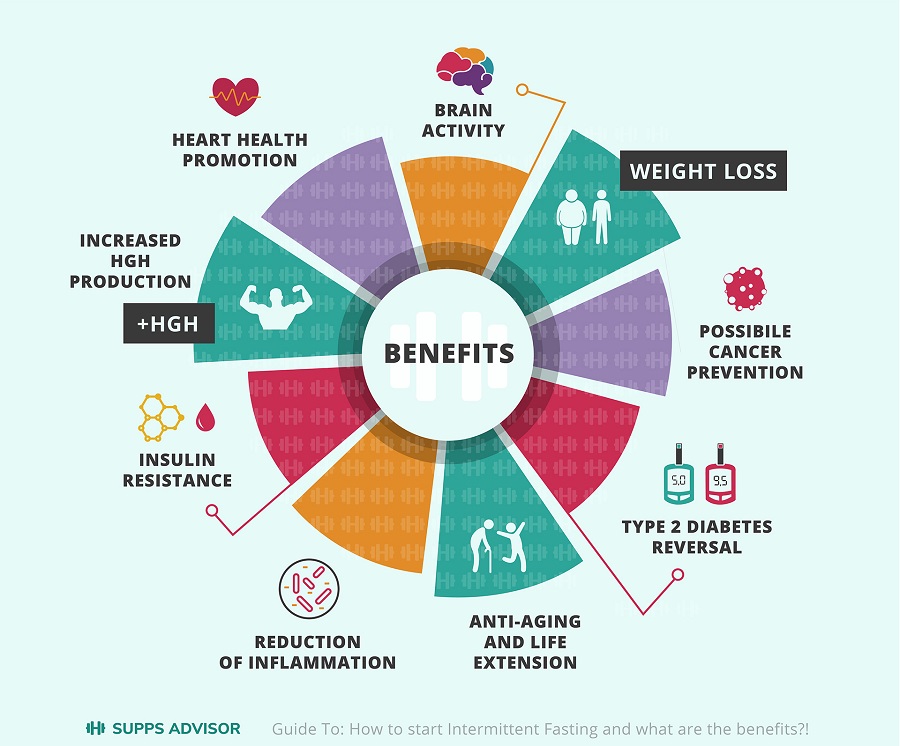
Benefits of Intermittent Fasting from our friends at Supps Advisor

There are many types of intermittent fasting diet plans and eating schedules and I’ll detail them below but first let’s talk about what most people use IF for…


II. Intermittent Fasting for Weight Loss

By far the number one reason why I hear most people try intermittent fasting is because they are attracted to the possibility of using intermittent fasting for weight loss.

But does intermittent fasting for weight loss really work?

For our purposes, the reason why Intermittent Fasting seems to work for weight loss is basically common sense…

If you are restricting or eliminating calories consistently over time, then you’ll tend to lose weight. It’s not rocket science.

Remember, with intermittent fasting you are not eating for a predefined period of time (for example with 16/8 Intermittent Fasting you don’t eat for 16 hours). Now when you put yourself into this ‘fasting’ state and because you are not eating, you’re by definition restricting calories (at this during this time period) — and if you do that consistently over time you’ll lose weight.

So that’s it? Intermittent Fasting is just caloric restriction?

Not quite.

There’s a lot of more to the story about intermittent fasting for weight loss, so I wrote a separate article about it. You can read it here…(click the pick)
Article: Intermittent Fasting for Weight Loss

If you are interested in using intermittent fasting for weigh loss my article also include a plan for success as well as links to books on the topic.


III. Intermittent Fasting Schedules

What are the most popular types of intermittent fasting eating schedules?

There are many different versions of intermittent fasting. Here are the most popular types are…

  • Time Restricted Feeding (16/8, 14/10, 12/12) – where you don’t eat for 16 hours and eat all your food within the remaining 8 hours. I personally live the 16/8 Intermittent Fasting lifestyle and love it!
  • Eat, Stop, Eat (OMAD, 24-hour fasting, Whole Day Fasting) – as the name implies, you’re basically fasting for 23 hours and then eating One Meal a Day (OMAD) or going for a full 24 hours before eating.
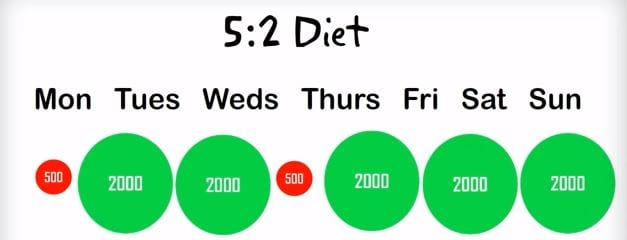
  • 5:2 Intermittent Fasting – With 5/2 Fasting you’ll be trying to limit your total daily calorie intake to only 500 calories for TWO DAYS during the week. The other 5 days you’ll be eating your typical (hopefully healthy) diet.
  • Warrior Diet – a type of Time Restricted feeding in which you do a version o 20/4 Intermittent Fasting where you eat little to no food for 20 hours and then eat one large meal at night during a 4-hour window.
  • Extended Day Fasting – 36 Hour Fasting, 48 Hour Fasting, and even 3-7 Day Fasting. I.E. the king of fasting. Yikes!

Because this is another in-depth topic, I wrote a separate article further detailing the types of intermittent fasting, you can read that by clicking this pic…
Article: Intermittent Fasting Eating Schedules

IV. Intermittent Fasting Results

As I mentioned, I’ve been a practitioner of the Intermittent Fasting lifestyle for about 2 years now and I can honestly say that this ‘diet’ has changed my life in many positive ways. I’ve written about the benefits of Intermittent Fasting on this blog numerous times in the past and today I’d like to share more of my Intermittent Fasting Results with you – providing transparency of results for 1 month, 3 months, 6 months, 1 year, and even now out to 2 years. 

You can read my full story here – it includes why I started intermittent fasting as a beginner, what my initial fears were about intermittent fasting, what my results were from 1 month through to 2 years, and what I learned along the way.

Read my intermittent fasting results article here…
Article: Intermittent Fasting Results

V. So What CAN You Eat During a Fast?

During the period while you are fasting (on most of the intermittent fasting schedules) pretty much all you can have is black coffee or simple tea. Some research suggests you can add some cinnamon (for blood sugar control) to the coffee (and I do this).

What about Butter or Coconut Oil?
There is also a LOT of debate (see references below for a sample) about whether you can also add in ‘good fats’ like grass-fed butter and/or coconut oil to your morning tea or coffee and that this won’t break the fast because apparently these good fats…

  1. Keep you in the ketosis (fat-burning state).
  2. They don’t spike an insulin response like eating carbs would.
  3. They provide your brain-food (the fat is used by your brain for energy).
  4. So long as you keep it under 50 calories from these good-fats you are supposedly still fasting.

Look, I’m not scientist here and I can’t tell you with medical research certainty if any of this is this is true or not, all I can tell you in that my experiments have shown and for me, using 1/2 TBSP of grass-fed butter in my coffee works (and has generated the results you’ll read in my personal story about intermittent fasting).

As a side note, I love the coffee + cinnamon + butter combo so much I developed a recipe for it. Check it out here…

My coffee + butter recipe

For further reading about what you can eat DURING a fast see the references below.


VI. Intermittent Fasting Tips – The Video

Here’s a video I made at the 6 month mark of Intermittent Fasting.

https://youtu.be/mv6VvwM81pY


VII. Intermittent Fasting Tips

These are the tips I collected after practicing Intermittent Fasting for a full year.  If you’re planning to try Intermittent Fasting for beginners I’d recommend you consider using some or all of the following:

  1. Skipped Days = Lethargy: you can skip a day or two if you like but I discovered that when I skipped an Intermittent Fasting day, I felt poor physically – specifically, I felt lethargic, unmotivated, and bloated. As a result I rarely skip a day of fasting and usually get in at least 14 hours. 
  2. Fasting Cardio vs HITT: the combo of Intermittent Fasting and Fasted Cardio (AKA Cardio before Breakfast) did increase my energy level but I still think longer HITT later in the day is more effective because you can burn more calories overall. I think an alternating combo of the two is best.
  3. Workouts Burn Even More Fat: CrossFit and other constant movement workouts worked particularly well from an energy standpoint. There is also the theory that working out larger muscle groups (legs, chest, back, etc) and building up those muscles will continue the post-workout fat-burning process longer (see topic #6 of this post and many others).
  4. Fluids are a Must: Drinking 1 glass of water immediately upon waking and then my Cinnabun Coffee Cup was more than enough to take me through to 10-11am for the 16-hour fast cycle to work its magic. I also like adding in some turmeric to my coffee as well. Additionally a nice cup of green or moringa tea is also good if you want something more to drink too
  5. Eating Schedule is Flexible: When I am ready to break my fast (at 10-11am) I load up on protein – yogurt, milk, eggs, bacon, etc. I then eat lunch around 1.5-3 hours later, then have some fruit/snack around 330-4, and then dinner at 6ish. Many people say to avoid fruits because they are high in sugar and that impedes the fat loss – that may be true but I like fruits and believe their overall health benefits outweigh the negatives for long-term health.
  6. Strict DIET is NOT a must : At no time did I focus on any particular diet. I tried not to eat a bunch of junk but I wasn’t strict. So long as I was in the ‘eating window’ I ate what I wanted — for me that’s mostly protein and good fats but I still a fair amount of carbs too. I pretty much ate my normal pre fasting diet. That meant I didn’t eat a set menu of restricted foods – perhaps if I did do those things then Intermittent Fasting would be even more effective but as I said I’m just an Average Joe and I like keeping things simple.
  7. Eat Dinner Early: The key with Intermittent Fasting (at least for me) is to eat dinner early and avoid those late night snacks. DO that and you can cruise thru to 16 hours around 10 am with ease.
  8. Alcohol is a bit of a Problem: Alcohol appears to play a key role in the process. I love beer but unfortunately, so many of the beers I like (IPAs) are ‘heavy’ from a calorie standpoint and when I have a beer I usually want to have a snack too. All those calories add up – fast. My results were negatively impacted when I had more beers per month then when I didn’t. It’s not rocket science. I’m not willing to give up my beer and chicken wings completely so I realize that’s going to decrease some of the effectiveness of my Intermittent Fasting, but at the same time I look at it from a different POV: Intermittent Fasting helps me limit the negative impact of the beer so I can still enjoy it with less guilt. (The Power of Perspective is pretty cool, huh?)
  9. Caloric Restriction takes you to the next Level: I don’t like to count calories, but after 9 months of intermittent fasting I felt like I was hitting a plateau. At that point I decided to pay marginal attention to my calories and tried to make a conscious effort to stay in a net caloric deficit (basically consuming less calories than my body required which for me was approx 2,000 calories a day). I didn’t go crazy with this and I relied on basically just reading food labels and doing some simple math in my head to add up approximately what I was consuming throughout the day calorie-wise. When I added this into the mix it took my results to the next level – during the final 3 months I went from 154 lbs to 149 lbs and dropped 2 more inches from my waist. I realize this tip is not rocket science but it’s important to point out. I didn’t count calories religiously and I didn’t necessarily limit what I ate (I just ate less of it) and it worked for me. I suppose if you want to be more hard core on this, you’ll get even better results than I did, but as I’ve said all along, I want to use a method that is easy and is something I can live with over the long run. Here’s a link to calculate the calories YOU need to lose weight
  10. SMART Goals are ideal – Looking back now I can see that my 3-month goal to lose 4 inches off my belly was a bit unrealistic – especially when I didn’t stick to the original plan or change my diet much. Set yourself up for success by setting a reasonable goal. Looking ahead (since I still don’t plan to change my diet completely and I still want to drink beer, I’m giving myself more time  to reach my 32/32 belly/waist goal — I’ll keep you posted on my progress and you can subscribe to my blog for updates).

Meanwhile, I’ve since collected more key insights about intermittent fasting and you can read those in my personal journey with IF article.


VIII. Intermittent Fasting Resources

I’m just one guy and as I wrote already I don’t know everything there is to know about intermittent fasting. There are a lot of great references and books about Intermittent Fasting. Here are some of the resources I’ve found helpful, along with an assortment of top-rated books that you might find helpful if you practice intermittent fasting for beginners….

Intermittent Fasting References Overall:

Fasting Cardio References

Coffee + Butter References

Food vs Fasting References

Time Restricted Eating References:

Eat-Stop-Eat Fasting References:

5:2 Intermittent Fasting References:

Warrior Diet References:

Extending Day Intermittent Fasting References:


Intermittent Fasting – Have YOU Tried it?

If you’ve tried Intermittent Fasting, Fasting Cardio, have some killer Morning Ritual, or any related wisdom to share, please do so. I’m eager to learn your tips so we can help each other improve.

If this post helped you feel free to share it with a friend.

When you do these things we all win.

Enjoyed This Article?

Share it with a friend using this social media friendly images – perfect to pin, post, and pass along…
Intermittent Fasting – The Beginner’s Guide

What to Read Next?

    How to Take a Full or Partial Screenshot on Windows 10, a Chromebook, or a Mac

    If you’re looking for instructions on how to take a full or partial screenshot on your Windows 10 PC, your Chromebook, or your Mac computer, this brief article can help you. The instructions here are not unique and you can find them on plenty of sites, but I’m tired of looking them up elsewhere so I’m putting them on my site too. 🙂

    Table of Contents

    1. How to Take a Screenshot on a Windows 10 PC
    2. How to Take a Screenshot on a Chromebook
    3. How to Take a Screenshot on a Mac

    I. How to Take a Screenshot on a Windows 10 PC

    A. How to take a FULL Screenshot on a Windows 10 PC

    • Press the Windows Logo button+PrtScn buttons on your keyboard to save the screenshot to a file. This will save the full screenshot into a folder called Screenshots that is a sub-folder of your Pictures Folder under your This PC Menu.

    This is a really easy option, assuming you have it already installed on your PC (if not visit the Microsoft App store to download the new Snip & Sketch app). Then go to your apps and open (‘launch’) it. It’ll look like this…

    Snip & Sketch

    Once Snip & Sketch is open, you’ll be able to use this powerful little app to take full or partial screenshots, markup the pics, and much more. Just click the “NEW” button in the top LEFT of the tool’s menu to get started – here’s what it looks like…

    Snip & Sketch has a lot more to it than just screenshots so if you want to know more, check out this helpful article from WindowsCentral.

    • A 3rd option for a full screenshot is to Press the Windows Logo button + G to open the new Game Bar option in Windows 10. These screenshots will be in the Captures Folder which is a sub-folder of the VIDEOS Folder on your This PC Menu
    Windows 10 Game Bar Screenshot

    HowtoGeek has a nice article about screenshots if you’re more interested in this topic.

    B. How to take a PARTIAL Screenshot on a Windows 10 PC

    • The easiest way is to just press the Windows Logo + Shift Key + S key. Then you can select the area you want to take a partial screenshot of.
    • Use the Windows 10 Snip & Sketch Tool (formerly Snipping Tool app) as noted above.

    II. How to Take a Screenshot on a Chromebook

    Screenshots on a Chromebook are pretty simple. All the screenshots are stored in your FILES Folder.

    A. How to take a FULL Screenshot on a Chromebook

    Press the Control + Shift Window Key. It looks like this…

    Chromebook Full Screenshot Keys

    B. How to take a PARTIAL Screenshot on a Chromebook

    Press the Control key + the Shift key + the Shift Window Key. It looks like this…

    Chromebook Partial Screenshot keys

    III. How to Take a Screenshot on a Mac

    A. How to take a FULL Screenshot on a Mac

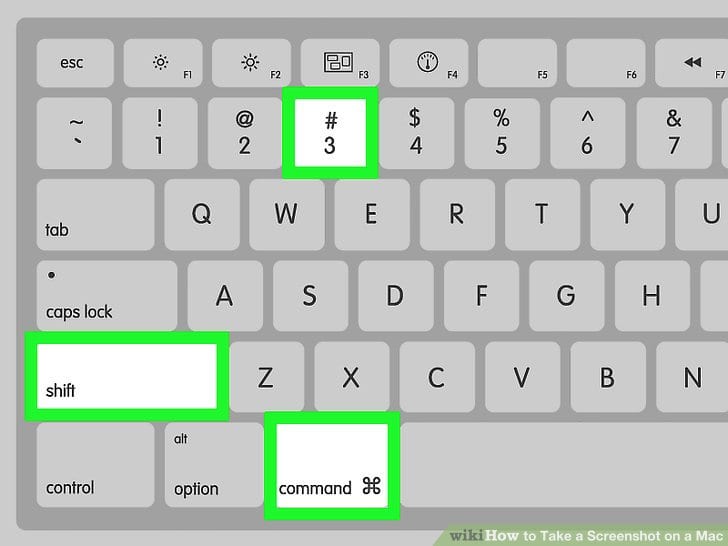
    Instructions from Apple: “Press Shift key + Command key + 3 key. Find the screenshot on your desktop.”

    Mac Full Screenshot – from WikiHow

    B. How to take a PARTIAL Screenshot on a Mac

    Instructions from Apple: “Press Shift key + Command key + 4 key. Drag to select the area of the screen to capture. To move the entire selection, press and hold Space bar while dragging. After you release your mouse or trackpad button, find the screenshot on your desktop.”

    Mac Partial Screenshot

    There are obviously other ways to take screenshots on your computer, but these are the ones I use because they seem to be the easiest. If you have one you recommend, let me know in the comments below.


    amzn_assoc_placement = “adunit0”; amzn_assoc_search_bar = “true”; amzn_assoc_tracking_id = “thathelpfulda-20”; amzn_assoc_search_bar_position = “bottom”; amzn_assoc_ad_mode = “search”; amzn_assoc_ad_type = “smart”; amzn_assoc_marketplace = “amazon”; amzn_assoc_region = “US”; amzn_assoc_title = “Shop Top Chromebooks”; amzn_assoc_default_search_phrase = “Chromebook”; amzn_assoc_default_category = “PCHardware”; amzn_assoc_linkid = “3ed97b559d840c0c9b59ab67d4c85a7b”; amzn_assoc_default_browse_node = “13900871”; //z-na.amazon-adsystem.com/widgets/onejs?MarketPlace=US

    What to Read Next

    Best Chromebooks
    Nest vs Ring Doorbell
    Search Google by Date

    Netflix Dark – Worth Watching? What’s it about?

    Netflix Dark – what’s this show about? Is it worth watching? In this video and text review, I’ll tell you about the Netflix series Dark and why I consider Dark to be one of the best Netflix Original Series – especially if you like science fiction and/or time travel stories. Have you watched Dark yet? Are you ready for Dark Season 3? Let’s get to it!


    Netflix Dark Video Review

    Netflix Dark Video Review

    Click Here to Share this vid
    Click here to Subscribe to our YouTube Channel
    Click here to watch our Cord Cutters Playlist


    About Dark on Netflix

    Netflix Dark is a mystery inside a riddle wrapped in an enigma – and that’s what makes it awesome.

    Netflix Show Synopsis: Throughout the series, Dark explores the existential implications of TIME and its effects upon human nature.

    Netflix Storyline: “When two children go missing in then small German town of Winden, its sinful past is exposed along with the double lives and fractured relationships that exist among four families as they search for the kids. The mystery-drama series introduces an intricate puzzle filled with twists that includes a web of curious characters, all of whom have a connection to the town’s troubled history — whether they know it or not. The story includes supernatural elements that tie back to the same town in both the past and the future.

    Did you know? Dark represents the first German original series produced for Netflix.

    Dark is not a show you can watch casually in the background!

    Because of the time-travel aspect and it’s affect on the characters, you have to pay attention when you’re watching. Personally I love this aspect of the show – it’s definitely a thinking person’s kind of show.

    Dark The Family Tree – Spoiler Alert

    STOP READING or SKIP this section if you don’t want any potential spoilers.

    The pic below is a “Family Tree” of the Dark Characters. Although you don’t necessarily need it to watch the show, if you get into the series, you’ll eventually find yourself wondering about the characters in their past, present, and future forms.

    The Dark Wikipedia Page and the Dark Family Tree image below may be helpful to you…

    Dark Family Tree

    Watch more Vids from our YouTube Channel


    You May Also Like

    Netflix Ozark
    Netflix Ozark
    Netflix Best Original Movies
    10 Questions about Stranger Things Season 3

    Intermittent Fasting Schedules – Most Popular Types of Intermittent Fasting

    Intermittent Fasting is all the rage these days, but what many people don’t realize is that Intermittent Fasting diet plans are not one size fits all – and that’s a GOOD thing. In this article, we’ll discuss the most popular types of intermittent fasting schedules. Hopefully you’ll find an intermittent fasting eating plan that works for you so you can benefit from this amazing lifestyle.


    Editor’s Note: This article is part of a series on Intermittent Fasting.

    Mike, That Helpful Dad

    Hi, I’m Mike, That Helpful Dad. I’ve been living the Intermittent Fasting lifestyle for about 2 years now and it’s changed my life for the better. I hope it can help you too.


    What is Intermittent Fasting?

    Intermittent fasting is a catch-all term for lifestyle diets in which someone doesn’t eat for a preset period of time (the fasting state) and does eat during a preset period of time (the fed state).

    Why would someone want to do that?

    Most people choose to try intermittent fasting because it helps with weight loss. However there are are a number of benefits to Intermittent Fasting too.

    For the purposes of THIS article, we’re going to assume you’ve already bought in to the benefits of intermittent fasting and are really just looking to better understand what the options are for intermittent fasting eating schedules.


    Most Popular Intermittent Fasting Schedules

    Depending on who you ask, if you research the types of intermittent fasting, you’re likely to see anywhere from 4 types of intermittent fasting, to 6 intermittent fasting diets, to 7 ways to try intermittent fasting, to even 15 different variations of intermittent fasting. Wow, who knew?

    I’m not here to judge what is and what isn’t really intermittent fasting – maybe there are really 15 different types or maybe there’s even more. After all the definition of Intermittent Fasting is pretty wide open to interpretation (a period of fasting vs a period of fed) so perhaps some of the lesser known types of intermittent fasting like Circadian Rhythm Fasting, Dry Fasting, and Fat Fasting qualify. But for our goals today, I’m going to draw your attention to the most popular types of intermittent fasting schedules since I’m assuming you’re likely to be pretty new to the concept. If that’s the case, then you’ll want to set yourself up for success by trying some of the tried and true methods of intermittent fasting eating plans that have been proven to work for many people (myself included).

    I. Time Restricted Feeding (16/8, 14/10, 12/12)

    Although I have no concrete evidence on this, I’m going to say that time restricted feeding is the most popular type of intermittent fasting eating schedule. I say this because it’s the most common type of intermittent fasting I hear people talking about in the real world. It’s also the version of IF that I follow and I’d like to be in the popular crowd so there’s that too. 🙂

    Here are the most popular variations of time restricted intermittent fasting.

    • 16/8 Intermittent Fasting means you don’t eat for 16 hours, and you eat all your food within an 8 hour window (fed). (This is the version most recommended for men).
    • 14/10 intermittent fasting means you don’t eat for 14 hours, and you eat all your food within a 10 hour window. (This is the version most recommended for women).
    • 12/12 intermittent fasting means you don’t eat for 12 hours, and you eat all your food within a 12 hour window. (This is more of a starting version to build from).

    Time restricted feeding is a really easy way to start intermittent fasting. Basically you don’t eat snacks after dinner and/or you skip breakfast. Consider what this looks like:

    16/8 Intermittent Fasting from our Friends at Supps Advisor
    • I practice 16/8 intermittent fasting so I try to stop eating around 6pm and then I don’t start eating until around 10am the next day.
    • If you do 14/8 IF and stop eating around 6pm, you can start again the next day at 8am. That’s easy.
    • And 12/12 IF is even easier. Stop eating around 7pm and start again at 7am. Easy-peesie. (Note: 12/12 IF is also called “Overnight Fasting”).

    I’ve been practicing 16/8 intermittent fasting for around 2 years – read my results in this article.

    What I love about 16/8 IF is that it’s a diet you can easily do every day, without feeling like you’re missing out or starving yourself. And because it’s so easy, it becomes a lifestyle you WANT to live.

    You can learn more about Time Restricted Eating here:


    II. Eat, Stop, Eat Fasting (OMAD, 24 Hours, etc)

    Moving on to a bit more advanced fasting. Within the Eat-Stop-Eat Fasting, you typically hear people talk about the following:

    • OMAD – This means “One Meal a Day” – most people define this as fasting for 23 hours and eating all your food in a 1 hour period. So this could also be called 23/1 Fasting.
    • 24 Hour Fasting – basically you eat normally (as you define it) one day, fast an entire day, and then eat normally again. Then repeat.
    • Also called “Whole Day Fasting”

    Those I know who practice this type of Eat-Stop-Eat Fasting love it. HOWEVER I don’t know anyone who does this consistently ever day. Usually I’ll hear people say they do this 2-3 times a week.

    That said, people who practice this type of fasting often proclaim the cleansing benefits of this lifestyle.

    You can learn more about Eat-Stop-Eat Fasting here:


    III. The 5-2 Method of Intermittent Fasting

    Not to be confused with Eat-Stop-Eat fasting, 5:2 Intermittent Fasting is a different animal. With 5/2 Fasting you’ll be trying to limit your total daily calorie intake to only 500 calories for TWO DAYS during the week. The other 5 days you’ll be eating your typical (hopefully healthy) diet.

    Most people who do 5:2 Intermittent Fasting will eat a 200 calorie meal and a 300 calorie meal and they’ll try to eat high-fiber, high-protein foods.

    5:2 Fasting is also called Twice a Week Fasting.

    A variation of 5/2 Fasting is Alternate Day Fasting (500 calories every other day) but the latter, while successful for losing weight, has proven to be hard to stick with over the long term for some people.

    To learn more about 5:2 Intermittent Fasting or Alternate Day Fasting, check out these links:


    IV. The Warrior Diet

    Whether it’s good marketing or something more, the Warrior Diet version of Intermittent Fasting has gained lots of popularity recently. As noted on Medical News Today, “supporters of the Warrior Diet claim that humans are natural nocturnal eaters and that eating at night allows the body to gain nutrients in line with its circadian rhythms.”

    Although it sounds hard – it’s proclaimed as a 20/4 Intermittent Fasting where you eat little to no food for 20 hours and then eat one large meal at night during a 4-hour window.

    That said, the Warrior Diet isn’t really a time restricted diet (if we define time restricted fasting as a period of NOT eating followed by a period of eating), because during the 20-hour ‘fasting’ window of the Warrior Diet you’re allowed to eat minimal amounts of raw fruits and vegetables.

    While I am not here to say if the Warrior Diet is a true version of Intermittent Fasting, the fact is that most people do define it as an Intermittent Fasting Schedule so we’ll include it here too.

    More importantly though, if you choose to follow the Warrior Diet Fasting plan, you may want to read more about the science behind Intermittent Fasting in general – especially if your goal is to use intermittent fasting for weight loss because if you eat more than 50 calories during the 20 hour ‘fasting’ window you MAY not stay in the ‘fasting state’ as effectively as you do with other forms of intermittent fasting (see the science behind the fasting state benefits of intermittent fasting here).

    To learn more about the Warrior Diet, check out these links:


    V. Extended Fasting (Multiple Day Intermittent Fasting)

    Not for the feint of heart (and not for beginners of IF), Extended Day Fasting is pretty much what the name implies:

    • 36 Hour Fasting
    • 48 Hour Fasting
    • 3-7 Day Fasting

    All these forms of intermittent fasting schedules are more extreme versions of the IF diet. There’s a boatload of evidence that people point to as the cleansing benefits of these types of intermittent fasting variations but you’ll need to graduate to this level of fasting if you want to set yourself up for success.

    To learn more about Extending Day Intermittent Fasting, read these articles:


    Intermittent Fasting Schedules – The Bottom Line

    There really is something for everybody when it comes to Intermittent Fasting Eating Schedules.

    If you’re looking to get started, try one of the easier versions like 12/12 IF or 14/10 IF. All you really need to do is skip that after dinner snack.

    Give it a try and let me know how it works.


    What to Read Next

    Intermittent Fasting for Weight Loss
    The Best of Series

    Intermittent Fasting for Weight Loss

    If you’re looking for a diet program that can provide real results to help you lose weight, then you might want to consider Intermittent Fasting. In this article, we’ll discuss the benefits of intermittent fasting specifically from a weight loss perspective so you can decide if this lifestyle is right for you.


    Editor’s Note: This article is part of a series on Intermittent Fasting.

    That Helpful Dad

    Hi, I’m Mike, That Helpful Dad. I’ve been living the Intermittent Fasting lifestyle for about 2 years now and it’s changed my life for the better. I hope it can help you too.


    What is Intermittent Fasting?

    Since this article is focused specifically on Intermittent Fasting for Weight Loss, we won’t spend a lot of time on definitions. We have other articles that dive deeper into the science behind Intermittent Fasting and all the various Intermittent Fasting schedules you can use to tailor an IF lifestyle that works best for you.

    But, to ensure we’re on the same page, let’s give a simple definition for Intermittent Fasting as follows…

    Intermittent Fasting is “a diet plan that cycle between a period of fasting and non-fasting over a defined period.”

    A popular schedule for Intermittent Fasting is 16/8 for men or 14/10 for women. What that means is fasting for 16 hours and eating within an 8 hour window (or) fasting for 14 hours and eating within a 10 hour window. But other intermittent fasting schedules are options too – there is basically something for everybody with intermittent fasting.


    Intermittent Fasting for Weight Loss

    Will intermittent fasting help you lose weight? If so, how does intermittent fasting for weight loss work? Great questions, I’m glad you asked!

    Since most of my readers are Average Joe’s like me this is not a high science blog, I won’t bore you with the pathophysiology behind how Intermittent Fasting works at the metabolic level, (however there are some great articles on this I’ll link to in the references section below).

    For our purposes, the reason why Intermittent Fasting seems to work for weight loss is basically common sense…

    If you are restricting or eliminating calories consistently over time, then you’ll tend to lose weight. It’s not rocket science.

    Remember, with intermittent fasting you are not eating for a predefined period of time (for example 16 hours) – during this window you’ll be consuming little to no calories. Now when you put yourself into this ‘fasting’ state, a lot of potentially positive effects are occurring within your body that may benefit you beyond just the weight loss effect of IF, but given our focus on weight loss, the key here is that because you are not eating, you’re by definition restricting calories (at this during this time period) — and if you do that consistently over time you’ll lose weight.

    So that’s it? Intermittent Fasting is just caloric restriction?

    Not quite.

    Myself and other proponents of IF would argue that Intermittent Fasting is much more than just restricting calories – after all history has shown us that diets solely focused on calorie counting, calorie restriction, and other ‘starvation’ diets tend to not be effective over a long period because people can’t (and frankly don’t want to) maintain that type of diet for every long – and when they come off of that type of diet there is a high rebound rate where people tend to put back the weight the lost (and possibly even gain more).

    So what’s different with IF?

    Intermittent Fasting vs Calorie Restriction Diets.

    Will you likely restrict calories when you practice intermittent fasting?

    Probably.

    Does intermittent fasting REQUIRE you to restrict calories?

    No.

    Remember, intermittent fasting is basically a preset period not eating (the fasting state ) followed by a preset period of eating (the fed state; not to be confused with the feasting state). There’s nothing in the definition of IF or even in most of the various schedules associated with IF that specifically talk about calorie restriction.

    It’s important to understand the difference between IF and basic calorie restriction diets because if you don’t then you may not have success with Intermittent Fasting.

    Why?

    Because if you gorge yourself on junk food during the time of you eat with IF and you consume more calories then you need each day, then you will GAIN WEIGHT with intermittent fasting.

    Intermittent Fasting is NOT a Guaranteed Slam Dunk

    Oops!

    When I talk to people who are new to Intermittent Fasting I basically tell them that I stop eating around 6pm, skip breakfast and just have black coffee (or coffee with butter), and then start eating again at 10am. (I follow the 16/8 Intermittent Fasting version). Then, between 10am and 6pm I basically eat whatever I want.

    While that’s true, there is an important caveat – when I say I eat whatever I want, I don’t eat lots of junk food. Don’t get me wrong, I love chicken wings, beer, nuts, and I can crush a whole bag of Doritos if you give it to me. I DO still eat all those things. HOWEVER I don’t do that every day because, first off I don’t want to, and secondly, I know that Intermittent Fasting isn’t going to overcome poor eating habits.

    So I’ll say again, if you eat more calories than you need each day, then Intermittent Fasting isn’t going to be a weight loss solution for you and, more likely than not, you’ll probably gain weight with IF.

    That would be disappointing. I don’t want to see that happen to you.


    Intermittent Fasting for Weight Loss – a Plan for Success

    If you really want to succeed with using intermittent fasting for weight loss, then you do yourself a favor and find out how many calories you need per day to maintain your weight. To do this, use a caloric calculator (Healthline has one that’s free and easy to use here).

    As Healthline notes “an average woman needs to eat about 2000 calories per day to maintain, and 1500 calories to lose one pound of weight per week. An average man needs 2500 calories to maintain, and 2000 to lose one pound of weight per week.”

    So if you are looking to lose a pound a week, shoot for the daily calorie target associated with your personal situation. For me, the goal is APPROXIMATELY 2000 calories a day.

    I say ‘approximately’ because I don’t actually count calories, I just estimate them roughly throughout the day. In that sense, Intermittent Fasting is a fairly forgiving diet plan (so long as your estimates are not way off!).

    OK, I know my daily calorie goal, so now what?

    Once you know your daily calorie goal, then use Intermittent Fasting to help you achieve it.

    This is the real beauty of Intermittent Fasting – it makes is a LOT easier to achieve a daily calorie goal because you’re limiting the time period in which you are eating and from there it’s simple math.

    The less time you spend eating, the greater your chances of consuming less calories. This is the real key behind using Intermittent Fasting for Weight Loss.

    STOP RIGHT THERE – so basically you’re saying you still want me to starve myself? , Mike, this sounds even worse than a starvation diet because now I have to starve myself for longer periods of time. That sucks. No way!

    Intermittent Fasting = Starvation?

    WRONG!

    While it’s true that you won’t be eating for extended periods of time, you’re definitely NOT starving yourself. So long as you’re not eating a bunch of junk food, and you follow your normal healthy diet, you can eat whatever you want.

    Look, here’s the bottom line with IF – if you simply skip the after dinner snacks and skip breakfast, you’ll probably have a pretty easy time with Intermittent Fasting for weight loss.

    Seriously, is it really that hard to stop eating around 6pm and then not eat the next day till 8am (14 hour fast) or 10am (16 hour fast)? It’s not hard. I can do it and so can you.

    Eat what you want (within reason), but just eat that food during the intermittent fasting schedule that works for you. Do it consistently over time and watch the pounds (and your waist line) melt away.


    Intermittent Fasting for Weight Loss Resources

    One of the goals of our site is to curate quality content from other sites and share it with you. The following articles on intermittent fasting for weight loss may be helpful to you:

    Intermittent Fasting for Weight Loss Books


    What to Read Next?

    Live a Legacy Life
    How to Live a Legacy Life
    Best Foosball Tables

    Netflix Ozark – Worth Watching?

    Netflix Ozark – what’s this show about? Is it worth watching? In this vid, I’ll tell you about the show Ozark on Netflix and why I consider this to be one of the best Netflix Original Series. Have you watched Ozark yet? Are you ready for Ozark Season 3? Let’s get to it!

    Netflix Ozark Review – The Video

    Netflix Ozark Review

    Share this vid: https://youtu.be/NmNo1kF3R00
    Click here to Subscribe to our YouTube Channel
    Click here to watch our Cord Cutters Playlist


    About Ozark

    Ozark was created by Bill Dubuque (“The Accountant,” “The Judge”). The series stars Jason Bateman as Marty Byrde, a financial planner who relocates his family from Chicago to a summer resort community in the Ozarks. With wife Wendy and their two kids in tow, Marty is on the move after a money-laundering scheme goes wrong, forcing him to pay off a substantial debt to a Mexican drug lord in order to keep his family safe. While the Byrdes’ fate hangs in the balance, the dire circumstances force the fractured family to reconnect.


    Watch more Vids from our YouTube Channel


    You May Also Like

    Stranger Things Season 3
    Best Chromebooks
    Netflix Dark – Worth Watching?

    Minecraft Tips: More TNT Recipes | Let’s Make my Dad Explode!

    10 NEW Minecraft TNT recipes that you can craft in Minecraft 1.14. Learn how to make Seismic TNT, Split TNT, Arctic TNT, Chain Reaction TNT, Nuclear TNT, and more.

    “Hi, I’m Jax and today I’m using the More TNT datapack to see how many times I can blow up my dad. Which one is YOUR Fav TNT? Look below to see how you can play this data pack and get all the TNT crafting recipes in the vid.”

    “Will my dad survive getting blown up? Who’ll win this challenge?”


    Editor’s Note: This content is from my son Jackson’s YouTube Channel “Jackson’s Toy Box” – a family friendly gaming channel where Jax and his friends play games like Minecraft, Roblox, Lego games, and more. As you may recall, Jax & I previously wrote a book of Minecraft tips and with the re-emergence of Minecraft into popularity and the many life lessons the game provides, we’re pleased to be able to share Jax’s vids with you. Enjoy!


    Minecraft More TNT Recipes Video

    Minecraft MoreTNT Datapack Table of Contents for Video

    Use these links to skip ahead in the video

    • Arctic TNT crafting recipe 01:25
      • Arctic TNT Explosion 02:15
    • Nether TNT crafting recipe 02:55
      • Nether TNT Explosion 03:29
    • Sponge TNT crafting recipe 03:51
      • Sponge TNT Explosion 05:04
      • #SavetheFish 05:20
    • Anvil TNT crafting recipe 05:55
      • Anvil TNT Explosions 06:40, 06:55, 07:12
      • #It’s raining anvils 07:15
    • Seismic TNT crafting recipe 08:00
      • Seismic TNT Explosions 08:20 & 08:40
      • #WatchDadExplode 08:25
    • Split TNTcrafting recipe 09:38
      • Split TNT Explosions 10:00 & 10:35
      • #DadCheats 10:25
    • Volcano TNT crafting recipe 11:20
      • Volcano TNT Explosion 11:45
      • #Return to Anvil Mt 11:45
      • Meet my Beloved Horse 12:05 -can you NAME HIM?
    • Chain Reaction TNT crafting recipe
      • 12:35 Chain TNT Explosion 13:42
      • #BestReaction 13:52 aka I blew up my horse by mistake 😦
      • Meet my new horse and dog 14:00
    • Void TNT crafting recipe 14:30
      • Void TNT Explosion 15:35
      • #LifeLessons 15:40
      • LovingAnvilMt 16:33
    • Nuclear TNT explosion 16:45
      • Nuclear crafting recipe 17:25
      • #OMGNuclear 17:00
      • Mysterious Creeper 17:10
      • My new dog is on the nuclear bomb site! 17:35
      • Let’s explode 4 Nuclear TNT 17:42
      • #I’m about to die 17:53
      • The world explodes 18:00
      • What happened to my new dog? 18:17
      • The world on fire 18:25
    • Jax wins 18:35

    Share this vid: https://youtu.be/gFw1HUZxJJ0
    Join the Fun and Subscribe to the JTB Channel: http://bit.ly/2ZAqoEA
    Drop me a comment — Who’s got the funniest #?

    About Me:
    Hi, I’m Jax from Jackson’s Toy Box. Join the Fun here at the JTB Channel and watch my brother JeeHo and I talk about our favorite toys, play video games like Minecraft, Roblox, and TABS, and get into other hilarious hi-jinks. All our vids are family friendly.


    More TNT Datapack Acknowledgements

    • Thanks to Minecraft expert for BlueCommander for creating this data pack. You can get the MoreTNT datapack on his site: https://bluecommand.weebly.com/more-tnt.html
      • Note: All instructions for using the datapack are in his video – it’s really easy to do (even my dad can do it and he’s a noob).
    • Shout to @LogDOTzip for playing this data pack too.
    • YouTube Royalty Free Music in this video: “Apprehensive at Best” by Biz Baz Studio

    Watch to Watch Next?

    If you enjoyed Jax’s vids, check out these too…


    Want to learn about Minecraft AND life?

    Read The Diary of a Minecraft Dad for free on this site.

    Kamado Joe III – Classic III & Big Joe III – Reviews, Prices, Comparisons & More

    Kamado Joe III is here as Kamado Joe continues to innovate. Their latest revolutionary new products are the Kamado Joe Classic III and Big Joe III – the first of their kind kamados to feature a SlōRoller Hyperbolic Smoke Chamber. In this article we’ll review the Kamado Joe III, provide comparisons vs other popular kamados, check current prices, and give you links to learn more. Let’s get cooking.


    [lwptoc]


    Kamado Joe III Quick Look

    Official Kamado Joe Classic III Intro

    I. What is the Kamado Joe III?

    The Kamado Joe III is the newest line of kamados from the Kamado Joe company – one of the most popular manufacturers of kamados in the US and by far the most innovative kamado company. In addition to their kamado grills, prior innovations from Kamado Joe that have revolutionized the kamado industry include:

    The Kamado Joe III builds upon this tradition of innovation with a newly redesigned kamado that has been resized to the ideal specifications necessary to maximize the value of the all revolutionary new SlōRoller Hyperbolix Smoke Chamber.

    The Kamado Joe III’s new longer size leverages the power of Harvard science to transforms a Kamado Joe® into one of the world’s most optimal smokers.

    Kamado Joe says that by distributing smoke and heat in rolling, recirculating waves, the SlōRoller is able to surround your food in ‘clouds of delicious smoke’ while evenly distributing heat. The end result is enhanced flavor and significantly reduced hot spots.

    To learn even more about how the SloRoller works, visit the Kamado Joe SloRoller FAQ Page.

    The SloRoller Insert

    FAQ’s and Harvard Science tech is great but I’m just an Average Joe like you. I care about how the Kamado Joe III works for my cooks. I’m sure you do too. So let’s take a look at the Kamado Joe III in action with KJ chef John Setzler making some SloRoller Chicken…

    What else is new about the Kamado Joe III?

    The major update to the Kamado Joe is the longer body and the SloRoller insert, however that’s not all that’s new in the Kamado Joe III.

    You’ll still enjoy all the things you loved with the Kamado Joe II like the air-lift hinge, 3-Tier Divide and Conquer Cooking System, the Kontrol Tower top vent, the Stainless Steel cooking racks that come standard, the powder-coated aluminum side shelves, and the multi-panel firebox, however the Kamado Joe III also comes with:

    What sizes does the Kamado Joe III come in?

    The Kamado Joe II comes in three sizes so far. They are…

    Kamado Joe Classic III

    Kamado Joe Big Joe III

    Kamado Joe Pro Joe III


    II. What’s the Difference between the Kamado Joe III vs the Kamado Joe II?

    We discussed the major differences between the Kamado Joe II vs the Kamado Joe II above, but since I know nobody really reads a full blog article nowadays and instead scans to the parts they want, let’s talk about it again. (BTW if you DID read the above then just skip ahead – wait, isn’t that the problem?!?)

    So what’s the Kamado Joe III vs the Kamado Joe II – what’s the difference?

    It’s simple really…

    The Kamado Joe III features a longer body that is designed to house the new SloRoller Hyperbolic Chamber Smoke insert – the SloRoller for low and slow bbq cooking and promises enhanced flavor and fewer hot spots.

    Here’s what the difference looks like on the Kamado Joe Classic III vs the Classic II..

    Kamado Joe Classic II

    Kamado Joe Classic III

    How does the SloRoller work?

    This screen shot from the Kamado Joe website gives us a great idea of the ‘flow’ of smoke and heat in the Kamado Joe III using the SloRoller insert. Click the pic to see a larger view…

    Kamado Joe SloRoller

    Besides the SloRoller insert, the Kamado Joe III also includes a more heavy-duty nest (with bottom shelf) and a free ash basket. Otherwise the Kamado Joe III is very similar to the Kamado Joe II.

    In terms of the size difference, the Kamado Joe Classic III is nearly 3 inches taller than the Kamado Joe Classic II and the Kamado Joe Big Joe III is over 4 inches taller than the Kamado Joe Big Joe II.

    These size differences may be important to note if you are trying to include the Kamado Joe III into a built-in kitchen or custom kamado table.

    The CeramicGrillStore has a nice comparison chart if you want to see the full spec differences of the Kamado Joe III vs the Kamado Joe II. Or you can view them in detail on Kamado Joe’s site.


    III. Kamado Joe III vs the Big Green Egg

    This really isn’t a fair comparison. The Kamado Joe III features far and away more innovation than the Big Green Egg. However that doesn’t mean the Big Green Egg is a bad kamado. The fact is that the Big Green Egg is still one of the best kamados on the market today – you don’t remain a market leader in the kamado industry by producing a bad product. Big Green Egg’s are an awesome kamado (in fact I own both a BGE and an KJ) and you really can’t go wrong with either one.

    Here’s a side by side of the Big Green Egg Large vs the Kamado Joe Classic III…

    Big Green Egg Large

    Kamado Joe Classic III

    Did you know?

    The Big Green Egg can also be retrofitted to use many of the Kamado Joe innovations (for example you can use the Flexible Cooking System in a BGE and then use the Kamado Joe cooking inserts, you can put a JoeTisserie in your BGE or a DoeJoe, and you’ll probably be able to put the SloRoller insert in your BGE eventually too. Big Green Eggs are great and as a fellow Egghead I’m raising my beer to the BGE brand.

    So should you just buy a Big Green Egg?

    I’m not saying that. If you do, you’ll probably be happy. However, why not get the KJ III?

    Seriously, let’s call a spade a spade, right? It doesn’t take a rocket scientist to figure out that…

    With all the many innovations designed by Kamado Joe specifically for use in a Kamado Joe grill, the Kamado Joe III is the perfect kamado to make the most of all these great accessories.

    And if you buy into the Harvard science tech behind the redesign of the ceramic housing of the Kamado Joe III in order to take full advantage of the SloRoller smoke chamber, then you’ll be buying a Kamado Joe III yourself.

    What’s the bottom line on the BGE vs KJ III?

    Don’t overthink it – unless you are in love with green, get the Kamado Joe III and get cookin’!


    IV. Reviews of the Kamado Joe III

    You’ve pretty much already ready our review of the Kamado Joe III – we love it and are confident you will too.

    That said, if you’re like me, you probably like to read reviews from multiple trusted sources. This product is still quite new so there’s not a lot of reviews out there, but here are a few we found helpful…

    Here’s another helpful video from KJ’s John Setzler featuring a full walk-around and assembly of the Kamado Joe III. As a bonus he even cooks a boston butt!

    Should you upgrade to the Kamado Joe III?

    When considering upgrading from an old model of a great product you already love to a new model, it’s usually a tough question. For example, moving from the Kamado Joe Classic I or Big Green Egg Large to the Kamado Joe Classic II was indeed a tough call – the KJ I and BGE were already great kamados, so unless you really wanted the safety of the KJ II’s air-lift hinge or you needed a new firebox, etc, you might have had a hard time justifying the upgrade if your existing KJ I or BGE was still working well.

    But in this case, I think the upgrade question is far more in play.

    The Kamado Joe III ain’t your daddy’s kamado.

    The SloRoller redesign really is a game changer and makes an upgrade far more justifiable if you are in the market again.

    If you use your kamado to do a lot of low and slow bbq cooking, then you’ll really benefit from the Kamado Joe III being specifically designed for the SloRoller Smoke Chamber (check out that SloRoller Chicken vid again and see what I mean).

    If you have the funds and you want the best kamado on the market today, then buy the Kamado Joe III. Then send me a pic of all the great food you’re cooking – no better yet invite me over for a brew and some wings.

    Can you buy the SlōRoller Hyperbolic Smoke Chamber as an accessory for another Kamado Joe?

    Actually you can – or you will be able to soon. Kamado Joe plans to release the SloRoller insert as an accessory you can use to retrofit your older Kamado Joe (or Big Green Egg).

    You can sign up to be notified from Kamado Joe when the SloRoller is available or check back with us when we have it in stock at LordoftheGrills.

    The only caveat is this – Kamado Joe specifically says that when you put a SloRoller in anything other than the Kamado Joe III “it may not perform as well [because the SloRoller] insert is optimized for the shapes and sizes” of the Classic III and Big Joe III.

    That could be marketing puffery or it could be true. I guess it comes down to this – if you have the money, you’ll be able to enjoy the full benefits of the SloRoller by using it inside a Kamado Joe III. If you don’t want to upgrade, then it’s nice knowing you can still buy a SloRoller for your older Kamado Joe Classic, Big Joe, or Big Green Egg.


    V. Kamado Joe III Current Prices

    Kamado Joe Classic III

    Kamado Joe III

    Kamado Joe Big Joe III

    Kamado Joe III

    Kamado Joe Pro Joe III

    Kamado Joe III

    Kamado Joe III – It’s YOUR Call

    Well, what’s YOUR verdict? Have you bought the Kamado Joe III yet or will you be buying one soon?

    Let us know your thoughts in the comments below.

    Cheers!

    ~Pitmaster Mike


    Kamado Joe Accessories

    If you want recommedations for the best accessories to buy for your Kamado Joe, check out this article from That Helpful Dad…


    //z-na.amazon-adsystem.com/widgets/onejs?MarketPlace=US&adInstanceId=552c8242-16a9-4961-a32f-cef7dd618fb1

    How to Live a Legacy Life

    Are YOU living a Legacy Life? What does it even mean to live a Legacy life? In this article, we’ll talk about the concept of Living a Legacy Life; more importantly I’ll give you tips that can help you identify what you want YOUR legacy to be and ideas for how you can spend more time on actually living your legacy life.

    Read the word carefully – the word order is important here

    Editor’s Note: If you’re looking for a bit of wisdom for life, perhaps some of the tips on this page can help you. If you find something that’s particularly helpful, be sure to let me know with a comment below or send me an email, and also share the wisdom with a friend so they can benefit as well.


    What is a Legacy Life?

    Let’s get started by defining what a legacy life is. I would suggest we use the following: “a life that has a positive impact on someone else.”

    I added the ‘positive’ wording because I believe most of us would like to have a beneficial impact on others and I’m hoping that’s how you feel too.

    Could we peel back the onion on our legacy life definition? Obviously. But rather than get into the weeds, I suggest we just go with that simple definition for our purposes today. Cool?

    Do you have to be famous to leave a legacy?

    It doesn’t take a rocket scientist to understand that people like Ben Franklin, Leonardo Da Vinci, Isaac Newton, Marie Curie, and countless others of their ilk created a legacy that included FAME and individuals like this will long be remembered for the legacy they created. The world owes them a debt of gratitude for the work they left behind and untold millions of people continue to benefit from their legacies.

    But what about Average Joes like you and I? Do we have anything to look forward to from a legacy perspective?

    I’d argue that one need not be famous in order to live a life that creates a legacy. Instead I believe we all have the opportunity to live a Legacy Life because every one of us can do something that has a positive impact on someone else.

    So ask yourself – what will YOUR legacy be?

    Wait, perhaps the better question is…

    What do you WANT your legacy to be?

    If you already know what you want your legacy to be, then more power to you – you’ve already completed the first steps towards living a legacy life. However if you don’t know what you want your legacy to be it will be very difficult to live a legacy life because you won’t know what actions to choose to do (because they will help you create your legacy) and what actions to avoid doing (because they pull you further away from your goals).

    For most of my life I didn’t know what I wanted my legacy to be. As a result, I wasted a lot of time and effort pursuing activities that ultimately had nothing to do with my legacy life goals and therefore left me unfulfilled.

    Don’t let that happen to you.

    There’s a bit of Confused Joey in all of us, right?

    How Did I Figure out my Legacy Life Goals?

    It wasn’t until my early 40’s that I finally figured out what I wanted my legacy to be. That’s a shame because I obviously wasted a lot of time I can’t get back. But it can be different for you – with a bit of wisdom and direction, you can find out your own legacy life goals sooner and live your legacy life longer.

    How did I finally figure out my legacy life goals? How can YOU?

    I followed the advice and example of mentors like Tim Ferriss, Tony Robbins, and yes even Leonardo Da Vinci – I spent time journaling, free writing, meditating, and thinking about what I wanted out of life and how I wanted to be remembered when I was gone.

    The more time I invested in these activities, the more clear my vision of my ideal legacy life became.

    I suggest you do the same. Consider doing any of the following activities (or better yet ALL of them)…

    Tim Ferriss discusses his morning routine
    My personal morning routine
    • Pick a book from Tony Robbins and actually DO the ‘life design’ exercises (my favorite is still Awaken the Giant Within).
    • Start a journal (I actually use Google Docs to journal online so it’s available on all my devices whenever I think of an idea or want to write no matter where I may be). One of the best ways to discover your hidden legacy life goals is to engage in free writing.
      • What is free writing? Basically you just start writing and don’t stop until you run out of ideas. You don’t worry about punctuation, you don’t worry about format, you don’t worry about spelling, you just write.
      • You’ll be amazed at the ideas that emerge from deep within you when you just allow yourself to relax and write and see what comes out.
      • I wonder – what ideas are hidden inside YOU? Don’t you want to find out? Your legacy life goals are there, waiting for you to discover.
    • Read the book How to Think Like Leonardo Da Vinci (it may sound corny but it’s actually really productive AND fun). Who knows maybe there’s an artist inside you yet?
    • Meditate – it doesn’t have to be hardcore “OM” meditation like a Buddhist monk (although that’s cool too); it can just be you spending time alone, focusing on your breath for a few minutes, and allowing your mind to relax. I’ve found that once we disengage our minds from the everyday bustle of life, there’s a lot of great ideas floating below the surface consciousness that start to emerge – many of these ideas are likely related to your legacy life. Meditation helps to unlock them.
    • Keep this bit of wisdom always in view from the Gospel of John: “Do not work for food that spoils but for food that endures to eternal life.” (John 6:27) Think about how you spend your time. Are you wasting your time/life on that which is fleeting? Or are you planting seeds that will produce fruit that lasts beyond just your life? Creating food that endures is the key to achieving your legacy life goals.

    What’s the bottom line on how to discover your legacy life goals?

    Find out what activities work to help you discover your legacy life goals and keep doing them so that you can gain a clear vision of what you want your legacy to be.


    What are the benefits of KNOWING your Legacy Life Goals?

    When you become more aware of what you want my legacy to be, you will feel more empowered about life in general. Why? Because when you know your legacy goals, you’ll enjoy a significant benefit related to how you spend your time…

    You will know that IF you make conscious decisions every day to DO the activities that are related to your legacy, THEN you will be actively LIVING your legacy life.

    That’s an awesome feeling.

    It’s a FULFILLING feeling.

    And perhaps just as importantly, because you’ll have this clear-eyed view (@JalenSmith) of your desired legacy, you will also be able to make conscious decisions each day on what actions to avoid. For example…

    • various time-suck activities;
    • pursuing seemingly easy but ultimately unfulfilling goals;
    • mindlessly chasing after money;
    • wasting time on TPS Reports 🙂
    • Etc, etc, etc.

    If certain daily activities are not related to your legacy goals then you should try to avoid doing them as much as possible.


    What are my Legacy Life Goals?

    Because I always try to be honest and transparent with you on this blog, I will share my legacy life goals with you. Although they may not mean much to you, perhaps they will give you some ideas that you can use in shaping your own legacy goals.

    Michael’s Legacy Life Goals are…

    1-Family Goals: each day I strive to be an awesome husband & father – that means spending time with my family and being actively involved in their lives every day. Here are a few examples…

    • Ideally I try to have a specific action item for each person every day. For example taking a walk with my wife, reading a book with my 5 year old, drawing with my 10 year old, and getting kisses from my little yorkie Bella. It doesn’t have to be complicated because all these little things add up to a lot over time.
    • I also try to consciously savor the “Now” moments of every day life by taking a mental snapshot of the moment while I am living it and encouraging my loved ones to recognize the moment as well. This helps to create a string of lasting memories for all of us that build a mutual legacy.
    Alec has the right idea…
    • Finally, my family goals also include helping each member of my family identify and develop a plan to reach their own legacy life goals. I’m trying to position myself as a ‘foundation of resources’ that family can build upon to pursue their own legacy (whatever that may mean for them).

    2-Body-Mind-Spirit Goals: every day I strive for continuous self-improvement in the three areas of Body, Mind, and Spirit as I endlessly pursue the noble but unattainable vision of becoming a Body-Mind Master. This includes individual goals related to fitness, meditation, spirituality, and overall continuous self-improvement. I won’t bore you with specifics here because I’m sure you already have your own goals related to these categories, but I would point out that this is a THREE-Prong approach: building up your body and mind is great, but don’t forget to develop your spiritual relationship too.

    Spending time each day ACTIVELY trying to grow closer to God can have profound positive effects on all the other areas of your life too. Try it. You’ll like it 🙂

    3-Novel Writing: I enjoy writing books. So far I’ve written a handful of them and while none have made it onto any best-seller lists, I still enjoy pursuing the craft of writing because I feel that God has blessed me with a treasure trove of creative story ideas and a passion for exploring them. And so I write.

    • Ideally I write every day. It may not be a lot – in fact it usually isn’t — but at least it keeps me in touch with my stories.
    • I write for my own self-happiness and also in an effort to emotionally touch others (thus the legacy impact).
      • To be completely honest with you, had I known my legacy life goals sooner in life, I wouldn’t have been in such a rush to leave home and instead would have pursued a career in writing from college. But the past is the past and can’t be changed. I’m grateful that I know my path now and still have plenty of time (hopefully) to pursue it.
    • If you are a writer (or want to be), perhaps the best tip I can give you is one I heard from Tim Ferriss who said “my quota is to write two crappy pages per day. I keep it really low so I’m not so intimidated that I never get started.”
      • Why does this wisdom work? Because the concept of 2 crappy pages of writing per day is achievable and realistic for anyone and when you consistently do it each day over time you end up with a lot of content. Most of it may indeed be crap, but there’s also a lot of gold in there that you would never have written if you weren’t consistent.
    • Here’s a few of my books…
    Fantasy Novelette
    Lessons about Minecraft & Life
    Fictional Trilogy about The Book of Revelation
    Life Lessons from our Yorkie Sassy
    Book I of a new fantasy series
    • It’s interesting to note that, although I’ve been dabbling with writing for most of my life, I never actually finished any books until I discovered my legacy life goals.
      • In other words, although many of these stories have been with me for years, until I gained that clear-eyed vision of my goals and actually made the conscious decision to work on them I didn’t accomplish anything. I was living the age old cliche “a goal without a plan is just a dream.”
      • After learning how to live my legacy life, I’ve jump-started my writing career — all of these books were written AFTER I turned 40.

    4. Self-Actualization Goals: I can’t remember when I first heard about Maslow’s Hierarchy of Needs (probably about 30 years ago) but this wisdom immediately stuck for me and I buy-in to the concept. If you’re not familiar with Maslow’s work, here’s a helpful graphic…

    • For me personally, anything above the Love/Belonging step relates to living a legacy live, but as relates to the Self-Actualization step specifically, I have certain activities that provide me with a sense of fulfillment.
    • My self-actualization legacy goals are related to pursuing the crafts of cooking, photography, and music/piano.
      • But how are these related to my legacy?
      • Because each of these activities can be shared with others – particularly friends and family and my hope is that by spending time with my loved ones doing these activities, we’ll be creating more of those precious Now Moments and building a stronger mutual legacy together.
    • I don’t get a chance to work on these every day or even every week, but when I do, my day is undoubtedly brighter.
    • What types of Self-Actualization activities are fulfilling to YOU? Is there a way you can spend more time doing them? If so, how much more fulfilling would your life be?

    5 – Sharing Wisdom with Others (like YOU): Part of what I want my legacy to be is to be known as a person who shares meaningful advice, helpful tips, and life-changing wisdom with others.

    • That sounds like a tall task, but hey, why not shoot for the stars, right?
    • My goal is to share wisdom with others that’s helped me in the hopes that it will help you too.
    • Often I share life lessons and certain wisdom that I wished I’d known earlier in life because I know it would have made a difference for me – wisdom that, once you know it, can make a difference for you too.
    • My blog ThatHelpfulDad.com, YouTube Channel, books, and other online and real-life activities are often related to this goal and each day I am consciously on the look out to share helpful wisdom with people I run in to (because you never know if the seeds you plan can change someone’s life for the better).

    But enough about me. Hopefully this part was helpful to give you some ideas.

    Let’s talk more about YOU…


    Further Resources to Discover your Legacy Life

    Living a legacy life is not complicated. If you simply try to enjoy more of your life as you are living it  — consciously focus on the NOW Moments that occur in your life and happily sharing you time/attention/essence with the ones you love. Spend time DOING your legacy life goals and you’ll find more fulfillment in life.

    Here are some additional articles from myself and others about living a legacy life:

    You May Also Like These Articles

    Kareem’s Legacy Life
    Affirmations for Dads
    Jim Craig’s Life Lessons
    Do What You Love
    Choose Happiness over Money
    Affirmations for a Legacy Life
    Your New Morning Routine?

    10 Best Books on Real Estate for Beginners and Beyond

    One exceptional way to generate wealth while enjoying favorable tax benefits is to invest in real estate. In this article, we’ll give you 10 recommendations for books about investing in real estate – this list includes books suitable for beginners looking to get started in real estate investing, all the way up to seasoned pro’s who have been investing in real estate for years and know the three keys to success…

    Location + Cash Flow + Tax Advantages.

    Best Books Real Estate

    Editor’s Note from That Helpful Dad: This article is written by Michael Thomsett – one of the most-published authors in the world on the subject of investing.

    Michael Thomsett has been actively involved in the investment world for over 40 years and has published countless books on finance and investing. At ThatHelpfulDad.com we’re thrilled to be able to showcase more of Michael’s work for you and hope you enjoy learning from him.

    Perhaps most importantly, Michael Thomsett has been a friend and mentor to That Helpful Dad for over a decade. My life has been improved from Michael’s wisdom and I hope yours will be too.

    DISCLAIMER – all the information you see here is for educational purposes only. Neither Michael Thomsett nor anyone at ThatHelpfulDad.com is recommending you make any investments based on what you read here. Please consult with a licensed financial advisor before you make any investment decisions.

    1-The Book on Rental Property Investing.

    Practical, real-world advice for those looking to build wealth and cash flow through rental properties!

    The Book on Rental Property Investing, written by real estate investor and co-host of the BiggerPockets Podcast Brandon Turner, contains nearly 400 pages of in-depth advice and strategies for building wealth through rental properties. You’ll learn how to build an achievable plan, find incredible deals, pay for your rentals, and much, more more! Real estate investing will never again be the same!

    If you’ve ever thought of using rental properties to build wealth or obtain financial freedom, this book is a “must-read.”

    Michael Thomsett loves this book because “This book explains how investors succeed or fail; easily applied strategies for beginners; tips on how to find the best deals; fixer-upper tips; financing guidelines; and tax planning suggestions.”

    2. The ABCs of Real Estate Investing

    “The ABCs of Real Estate Investing: The Secrets of Finding Hidden Profits Most Investors Miss (Rich Dad’s Advisors)” will teach you how to:
    – Achieve wealth and cash flow through real estate
    – Find property with real potential
    – Show you how to unlock the myths that are holding you back
    – Negotiating the deal based on the numbers
    – Evaluate property and purchase price
    – Increase your income through proven property management tools

    Michael Thomsett loves this book because “This book show how to control cash flow with real estate; locate the best investment properties; negotiate the best deals; evaluate price and property based on neighborhood, age and condition; and apply property management ideas.”

    3-The Millionaire Real Estate Investor

    The Millionaire Real Estate Investor is your handbook to the tried and true financial wealth building vehicle that rewards patience and perseverance and is available to all–real estate. You’ll learn:

    • Myths about money and investing that hold people back and how to develop the mindset of a millionaire investor
    • How to develop sound criteria for identifying great real estate investment opportunities
    • How to zero in on the key terms of any transaction and achieve the best possible deals
    • How to develop the “dream team” that will help you build your millionaire investment business
    • Proven models and strategies millionaire investors use to track their net worth, understand their finances, build their network, lead generate for properties and acquire them

    The Millionaire Real Estate Investor is about you and your money. It’s about your financial potential. It’s about discovering the millionaire investor in you.

    Michael Thomsett loves this book because “you will learn about the myths and realities of real estate; learn the criteria for finding the best deals; set up a team of experts to help the deal work well; and learn the proven strategies used by other successful investors.”

    4-What Every Real Estate Investor Needs to Know about Cash Flow

    What Every Real Estate Investor Needs to Know About Cash Flow removes the guesswork from investing in real estate by teaching you how to crunch numbers like a pro, so you can confidently judge a property’s value and ensure it provides long-term returns.

    Real estate expert, Frank Gallinelli has added new, detailed investment case studies, while maintaining the essentials that have made his book a staple among serious investors. Learn how to measure critical aspects of real estate investments, including:

    • Discounted Cash Flow
    • Net Present Value
    • Capitalization Rate
    • Cash-on-Cash Return
    • Net Operating Income
    • Internal Rate of Return
    • Profitability Index
    • Return on Equity

    Whether you’re just beginning in real estate investing or you’re a seasoned professional, What Every Real Estate Investor Needs to Know About Cash Flow has what you need to make sure you take the smartest approach for your next investment using proven calculations.

    Michael Thomsett says “This book provides guidance about cash flow, which matters more than profits. It explains cash flow and how it works and also introduces key formulas every real estate investor needs to know – formulas you will use for your entire real estate investing career.”

    5. How to Invest in Real Estate – The Ultimate Beginner’s Guide

    Unlike most traditional real estate books, this one won’t tell you there is “one secret path” to real estate success. Instead, it dives into dozens of unique, life-changing quests and is packed with more than forty real-life stories of how real estate investors are finding success in today’s economy.

    What’s inside:

    • How to invest in real estate while working a full-time job
    • The truth about LLCs and corporations
    • How to earn more at work (or on the side) so you can invest more
    • Getting your spouse on board with real estate investing
    • Eight unique property types you can invest in today
    • Eleven powerful strategies for building wealth through real estate
    • Twenty-eight tested methods for finding great real estate deals
    • Partnerships, BRRRR investing, and other creative ways to fund your deals
    • And so much more!

    Michael Thomsett says “This book shows how to be a real estate investor while still keeping a day job; eight different kinds of property; powerful strategies to build wealth; and proven methods for finding great deals.”

    6-Investing in Rental Properties for Beginners

    If being a real estate investor is your dream and being a landlord is not, this is the book for you! The author will personally take you through the steps she’s used on over 560 people to build their dream income and lifestyle.
    Here’s some of what you’ll discover in this book:

    • Find what the best market/price for your investment portfolio should be for your budget;
    • Learn how to invest out of state EASILY and EFFORTLESSLY to build your portfolio;
    • How to find low cost properties and analyze them to make sure you are choosing the right property;
    • How NOT to be swindled out of thousands by contractors;
    • The Three KEY FACTORS that determine whether it’s a good deal or not;
    • How vacancy rates is a MADE UP NUMBER and how to professionally analyze any rental market;
    • The difference between a rental property owner versus landlord – and how that impacts your investment strategy;
    • That there is such a thing as a profitable and compassionate real estate investor, and you can do your part to offer long term affordable housing and stop the middle class squeeze;

    If you’re ready to turn your dreams of being a real estate investor into a reality, then hit the BUY NOW button!

    Michael Thomsett says “This book shows you how to find the best market and the best price; find low-cost properties; how to work with contractors without getting swindled; key factors defining a good deal; the difference between being an owner and a landlord; and much more.”

    7. Anyone Can Invest in Real Estate

    This book will go over topics like Financing, Rentals, Fix and Flips, Business Plans and many more important topics.

    This book is not a motivational book, this is a Real Estate Investing Guide.

    To be a successful real estate investor you need to do research to build a good foundation of knowledge. “ANYONE Can Invest In Real Estate” has all the information you need to start your career and be a successful real estate investor.

    Michael Thomsett likes this book because “it teaches you all about financing, rentals, flipping, business planning, and detailed information about every aspect of finding and profiting from properties.”

    8. The Real Estate Rehab Investing Bible

    This book gives you the information,education, and systems every investor needs to start flipping and rehabbing houses without doing the work yourself,and without losing your shirt to contractors and bad investing decisions.

    Find Deals: where and how to find deals, analyzing deals,and estimating repairs in minutes to acquire a rehab

    Fund Deals: where and how to borrow money, creative financing, and the finance request template to present to asset based lenders and private lenders to fund your deal

    Fix Deals: how to run a rehab with a proven system without lifting a hammer, identify A+ licensed and insured contractors at wholesale pricing, and what to focus on to maximize your profit

    Flip Deals: how to properly price, stage, and add the sizzle features to get properties sold within weeks of listing the property by properly analyzing comparables and staging the rehab properly

    The proven techniques Paul shares work in any location, in any market. If you’re ready to get in the game, The Real Estate Rehab Investing Bible teaches you how to play.

    Michael Thomsett says “Learn how to turn the ugliest house on the block, into the best house; and in the process, make a tidy profit when you sell. This book explains how to evaluate property to flip, set and stay within a budget, and assess profit potential as well as risk. This market offers great opportunities that too many investors are not willing to take.”

    9. 50 Real Estate Investing Calculations

    When Real Estate Investors say, “I wish I’d known that,” this is what they are talking about.

    Real Estate Investing Calculations are the Rules of Real Estate Investing, and you won’t be successful without knowing them.

    Real Estate Investing offers you four huge benefits that other forms of investing do not.

    1. Cash Flow
    2. Asset Appreciation
    3. Financial Leverage
    4. Special Tax Treatment

    But your success will depend on how well you estimate these items before you purchase a property, and how well you manage them after you purchase.

    A basic rule of Business Management is “In order to manage, you must first measure.” And that’s the purpose of Real Estate Investing Calculations. They are the tools of your trade, regardless of where your interest lies.

    Here are just some of the topics this book addresses:

    * Negotiating Real Estate * Rental Property * Fix and Flip * Financial Freedom * Great Deals * Flipping Houses * Estimating Rehab Costs * Investing in Foreclosures * Buying Without Cash or Credit * Multi-Family * Managing Rental Property * Rehab Investing * Property Management * Section 1031 Exchange * Triple Net Lease * Delaware Statutory Trust * Real Estate Exam * Lease Agreements * Apartment Rentals * Self Directed IRA Investing * Lowering Your Taxes * Business Tax Deductions * Tax Strategies * Real Estate Finance * Money Lending * Real Estate License * Due Diligence * REIT * NNN * Real Estate Development * Mortgage Broker * Rental Agreements * Apartment Buildings * Site Selection * Loopholes * Limited Liability Companies * Limited Partnerships * Tax Free Income * Exchanging Properties

    Michael Thomsett likes this book because “This book explains all of the essential calculation every real estate investor needs. One thing you don’t need to benefit from this book is an advanced math degree; it breaks down all you need and also provides links to easy-to-use free online calculators.”

    10. Rental Property Profits: A Financial Tool Kit for Landlords

    Real estate investing doesn’t have to be risky. With rental prices climbing, vacancy rates low, and property values rising, real estate investing has become a tempting option for achieving financial security.

    The idea is simple: buy a property, fix it up, and then rent it until you’re ready to sell. But the reality can be confusing, requiring in-depth financial and tax knowledge that most newcomers lack.

    Rental-Property Profits walks you through every important step, from spotting smart investments to taking advantage of tax breaks and loop holes. With clear language and updated forms, worksheets, checklists, and formulas, this new edition explains how to:

    • Evaluate risks and opportunities in a post-recession market
    • Determine if you qualify for an investor loan
    • Calculate cash flow and maintain healthy levels
    • Establish sound bookkeeping and accounting systems
    • Handle rental property depreciation
    • Report annual income and expenses accurately
    • And much more

    Housing is bouncing back, and the number of real estate investors is growing. This book will help build your nest egg, while bypassing costly mistakes.

    Michael Thomsett likes this book because “it walks you through every important step, from spotting smart investments to taking advantage of tax breaks and loop holes. With clear language and updated forms, worksheets, checklists, and formulas, this new edition explains how to:

    • Evaluate risks and opportunities in a post-recession market.
    • Determine if you qualify for an investor loan.
    • Calculate cash flow and maintain healthy levels.
    • Establish sound bookkeeping and accounting systems.
    • Handle rental property depreciation.
    • Report annual income and expenses accurately.

    It all that isn’t enough of an endorsement then consider this as the best reason of all – I am the author of this fabulous book so I encourage you to buy it today and let me know what you think!”

    Enjoyed this article?

    Here are a few ideas to read next…