
Category Archives: Wisdom for Life

How to make your Morning Routine Successful

I’ve written multiple times about how creating a successful morning routine can significantly impact your productivity, mood, and overall well-being. The key to a successful morning is a combination of thoughtful planning, discipline, and positive habits that set the tone for the rest of your day. Here’s a comprehensive guide with specific ideas and examples to help you craft a morning routine that leads to a successful day.

1. The Importance of a Morning Routine

A well-structured morning routine helps you start your day on the right foot, reduces stress, and increases productivity. By establishing a set of habits that you follow every morning, you can create a sense of stability and control over your day. Moreover, a morning routine can enhance your mental and physical health, setting a positive tone that carries throughout the day.

2. The Night Before: Preparation is Key

A successful morning starts the night before. Preparing for the next day can significantly reduce morning chaos and decision fatigue.

  • Plan Your Day: Spend a few minutes each evening reviewing your schedule for the next day. Make a to-do list prioritizing the most important tasks. This helps you wake up with a clear sense of purpose.
  • Set Out Clothes: Choose and lay out your outfit for the next day. This simple step can save you time and reduce stress in the morning.
  • Prepare Your Breakfast: If you have a busy schedule, consider preparing breakfast the night before. Overnight oats or pre-made smoothies are excellent options.
  • Limit Screen Time: Avoid screens at least an hour before bed to ensure a good night’s sleep. The blue light from devices can interfere with your sleep quality.

3. Wake Up Early

Waking up early gives you a head start. It allows you to have some quiet time before the demands of the day begin. Aim to wake up at least an hour before you need to start your day.

  • Consistent Wake-Up Time: Try to wake up at the same time every day, even on weekends. This helps regulate your body’s internal clock.
  • Gradual Wake-Up: Consider using a sunrise alarm clock that gradually increases light, simulating a natural sunrise to wake you up gently.

4. Hydrate First Thing

Rehydrate your body after hours of sleep. Drinking a glass of water in the morning kickstarts your metabolism and helps your body wake up.

  • Add Lemon: Did you know? Adding a slice of lemon to your water can enhance flavor and provide a boost of vitamin C, aiding your immune system.
  • Keep Water by Your Bed: Place a glass of water on your nightstand so you can hydrate immediately upon waking up.

5. Practice Mindfulness or Meditation

Starting your day with mindfulness can reduce stress and improve focus. Meditation, deep breathing exercises, or a few minutes of quiet reflection can help you set a positive tone for the day.

  • Guided Meditation Apps: Apps like Headspace or Calm offer guided meditations tailored to different needs and time frames.
  • Deep Breathing Exercises: Practice deep breathing exercises for a few minutes. Inhale deeply through your nose, hold for a few seconds, and exhale slowly through your mouth.

6. Move Your Body

Physical activity in the morning can boost your energy levels and mood. It doesn’t have to be a full workout; even gentle stretching or a short walk can be beneficial.

  • Morning Yoga: Yoga can be a gentle way to wake up your body and mind. There are many online resources and apps with routines tailored for the morning. Track Yoga app is a great tool here.
  • Short Workouts: If time allows, a 20-30 minute workout can significantly boost your energy levels. Consider activities like jogging, cycling, or a quick HIIT session.
  • Stretching Routine: A 5-10 minute stretching routine can improve flexibility and reduce tension.

7. Healthy Breakfast

A nutritious breakfast fuels your body and brain. Aim for a balanced meal with protein, healthy fats, and whole grains.

  • Quick and Nutritious Options:
  • Greek yogurt with nuts and berries.
  • Whole grain toast with avocado and a poached egg.
  • A smoothie with spinach, banana, almond milk, and protein powder.
  • Overnight Preparations: Prepare overnight oats or chia pudding the night before for a quick grab-and-go option.
  • For those who like to practice Intermittent Fasting like myself, consider my Cinnabutter Coffee tip.

8. Personal Development

Allocate time for personal growth. This could involve reading, journaling, or learning something new.

  • Reading: Spend 10-20 minutes reading a book that inspires or educates you.
  • Journaling: Reflect on your goals, express gratitude, or simply jot down your thoughts. Journaling can clarify your mind and set a positive intention for the day.
    • My “AM Journals” are kept in an online Google Doc and I usually end up with 200+ pages a year of journal notes – when I look back and review it provides so many insights that I can actively use to improve my life.
  • Skill Development: Use this time to learn something new, like practicing a language on Duolingo or taking a short online course.

9. Plan and Review Your Day

Take a few minutes to review your day’s schedule and prioritize tasks. This helps you focus on what’s important and avoid feeling overwhelmed.

  • Top 3 Priorities: Identify your top three priorities for the day and focus on completing them first. I like using Tim Ferriss’ “Three to Thrive” method.
  • Time Blocking: Allocate specific time slots for different tasks to ensure you stay on track.

10. Positive Affirmations

Starting your day with positive affirmations can boost your confidence and mindset. Affirmations are simple, positive statements that you repeat to yourself.

  • Examples of Affirmations:
  • “I am capable and strong.”
  • “Today is going to be a productive day.”
  • “I am grateful for the opportunities this day brings.”
  • Creating Your Own: Tailor affirmations to your personal goals and needs.
  • As I’ve written about before, affirmations have changed my life many times over.

11. Limit Distractions

Minimize distractions to maintain your morning routine’s effectiveness. This can include reducing screen time and setting boundaries.

  • No Phone Zone: Avoid checking your phone immediately upon waking up. Emails and social media can wait until you’ve completed your morning routine.
  • Focus on the Present: Concentrate on each activity in your routine rather than multitasking. Mindfulness in your morning tasks can set a calm tone for the day.

12. Consistency and Flexibility

Consistency is crucial for establishing a successful morning routine. However, it’s also important to be flexible and adapt when necessary.

  • Stick to the Plan: Try to follow your routine every day, even on weekends. This helps reinforce the habits you’re building.
  • Adapt When Needed: Life is unpredictable, and sometimes you’ll need to adjust your routine. Don’t be too rigid; adapt and move forward.

Example Morning Routine

Here’s an example of a morning routine incorporating the elements discussed:

  1. 6:00 AM – Wake Up: Get out of bed and drink a glass of water with lemon.
  2. 6:05 AM – Mindfulness: Spend 10 minutes meditating using a guided app.
  3. 6:15 AM – Exercise: Do a 20-minute yoga session or a quick workout.
  4. 6:35 AM – Shower and Get Ready: Refresh and dress for the day.
  5. 6:50 AM – Breakfast: Enjoy a healthy meal, such as Greek yogurt with fruits and nuts.
  6. 7:10 AM – Personal Development: Read a book or journal for 15 minutes.
  7. 7:25 AM – Plan Your Day: Review your schedule and set your top three priorities.
  8. 7:35 AM – Positive Affirmations: Spend a few minutes reciting affirmations.
  9. 7:40 AM – Start Your Day: Begin your first task of the day with focus and clarity.

Tips for Success

  • Start Small: If creating a full morning routine feels overwhelming, start with one or two habits and gradually add more.
  • Be Patient: Building a new routine takes time. Be patient with yourself and allow for adjustments as needed.
  • Reflect and Adjust: Regularly reflect on what’s working and what isn’t. Adjust your routine to better fit your needs and lifestyle.

Give the Morning Routine a try today.

Crafting a successful morning routine involves thoughtful planning, consistent practice, and a willingness to adapt. By incorporating hydration, mindfulness, physical activity, a healthy breakfast, personal development, and planning into your morning, you set a positive tone for the rest of your day. Remember, the key to success is consistency, but also being flexible enough to adapt when life gets in the way. Start small, be patient, and enjoy the benefits of a well-structured morning routine.

What to read next?

Ashwagandha Mental Health Benefits for teens and adults.

Are you familiar with Ashwagandha? If not, you might want to learn about it – especially if you or someone in your family is having challenges with maintaining a positive mental outlook. In this article we’ll explore the basics about Ashwagandha and learn about its mental health benefits – including a story from my family about how it helped our teenage son. Links to learn more are provided. I’ll also give you a list of some of the specific Ashwagandha supplements we’ve been using in our family if you want to check the out for yourself.

What is Ashwagandha?

Ashwagandha is a revered herb in traditional Indian medicine and has been used for centuries to promote overall health and longevity. Also known as Withania somnifera or Indian ginseng, Ashwagandha is a cornerstone of Ayurveda, the ancient system of medicine from India. In recent years, it has garnered significant attention in the scientific community, particularly for its potential benefits in combating depression and enhancing mental health. This article delves into the properties of Ashwagandha, its historical use, and its modern-day applications, focusing on its role in mental health and depression management.

Historical Context and Traditional Use

Ashwagandha’s roots can be traced back over 3,000 years, where it was used to rejuvenate and enhance vitality. In Sanskrit, “Ashwagandha” means “smell of the horse,” suggesting that the herb imparts the vigor and strength of a horse. It has been traditionally used to treat a myriad of conditions, from physical fatigue and weakness to psychological disorders such as anxiety and insomnia.

The herb is classified as an adaptogen, a natural substance that helps the body adapt to stress.

Adaptogens are known to stabilize physiological processes and promote homeostasis, making them effective in managing stress-related conditions.

Ashwagandha’s adaptogenic properties have made it a popular remedy in modern herbal medicine, particularly for its purported benefits on mental health.

Chemical Composition and Mechanisms of Action

Ashwagandha contains several bioactive compounds, including withanolides, alkaloids, choline, fatty acids, amino acids, and a variety of sugars. The withanolides, particularly withaferin A and withanolide D, are considered the primary active compounds responsible for its medicinal properties. These compounds exhibit a range of pharmacological activities, including anti-inflammatory, anti-tumor, anti-stress, antioxidant, immunomodulatory, and neuroprotective effects.

The herb’s impact on mental health is thought to stem from its ability to modulate the hypothalamic-pituitary-adrenal (HPA) axis and balance cortisol levels, which play a crucial role in the body’s response to stress. By regulating the HPA axis, Ashwagandha helps reduce the levels of cortisol, the primary stress hormone, thereby mitigating stress and its associated symptoms.

Ashwagandha and Depression

Depression is a complex mental health disorder characterized by persistent sadness, loss of interest in activities, and a range of emotional and physical problems. It can result from various factors, including genetic predisposition, biochemical imbalances, and environmental influences. Traditional treatments for depression often include psychotherapy and pharmacotherapy, but these are not always effective for all patients and can come with significant side effects.

Ashwagandha offers a promising complementary approach to traditional treatments. Several studies have explored its antidepressant effects, with findings suggesting that it can effectively alleviate symptoms of depression.

Scientific Evidence

  1. Reduction of Cortisol Levels: Chronic stress and elevated cortisol levels are strongly linked to depression. A study published in the “Journal of Clinical Psychiatry” found that Ashwagandha supplementation significantly reduced cortisol levels in chronically stressed adults. This reduction in cortisol was associated with a significant decrease in symptoms of depression and anxiety.
  2. Neurotransmitter Modulation: Ashwagandha has been shown to influence the levels of neurotransmitters in the brain, including serotonin and gamma-aminobutyric acid (GABA). Serotonin is often referred to as the “feel-good” neurotransmitter, and its imbalance is a well-known contributor to depression. GABA, on the other hand, has a calming effect on the nervous system. By modulating these neurotransmitters, Ashwagandha can help improve mood and reduce anxiety.
  3. Neuroprotective Effects: Oxidative stress and inflammation are known to play a role in the pathophysiology of depression. Ashwagandha’s antioxidant properties help protect the brain from oxidative damage, while its anti-inflammatory effects further contribute to its antidepressant benefits. A study in the “Journal of Ethnopharmacology” demonstrated that Ashwagandha reduced oxidative stress markers and inflammation in animal models, leading to improved mood and cognitive function.
  4. Enhancing Sleep Quality: Poor sleep quality is both a symptom and a contributing factor to depression. Ashwagandha has been traditionally used to promote restful sleep. Clinical trials have shown that it can improve sleep quality and reduce insomnia, which can have a significant positive impact on mood and overall mental health.

Ashwagandha and Anxiety

Anxiety often coexists with depression, and managing it is crucial for overall mental health. Ashwagandha’s anxiolytic (anxiety-reducing) properties further enhance its potential as a holistic treatment for mental health issues.

Scientific Evidence

  1. Stress and Anxiety Reduction: A double-blind, placebo-controlled study published in the “Indian Journal of Psychological Medicine” evaluated the effects of Ashwagandha on stress and anxiety. The study involved 64 subjects with a history of chronic stress. The group that received Ashwagandha reported a significant reduction in stress and anxiety levels compared to the placebo group. The reduction in stress was also associated with improved overall well-being and quality of life.
  2. Comparative Studies with Conventional Anxiolytics: Another study compared the efficacy of Ashwagandha with that of a common anxiolytic drug, lorazepam. The findings indicated that Ashwagandha was equally effective in reducing anxiety, with the added benefit of fewer side effects. This suggests that Ashwagandha could be a viable alternative for those who experience adverse effects from conventional medications.
  3. Adaptogenic Benefits: By acting as an adaptogen, Ashwagandha enhances the body’s resilience to stress, which is a significant factor in the development of anxiety. Regular use of Ashwagandha has been shown to improve the body’s stress response, thereby reducing the likelihood of anxiety disorders developing in response to chronic stress.

Ashwagandha Supplementation

Dosage and Side Effects

The therapeutic dosage of Ashwagandha can vary depending on the form of the supplement and the specific health condition being targeted.

It’s important to include a discussion with your medical provider BEFORE taking any supplements like this.

Common dosages range from 300 to 600 mg of standardized Ashwagandha extract taken once or twice daily seem to be the norm. It is essential to choose high-quality supplements from reputable manufacturers to ensure safety and efficacy.

Ashwagandha is generally considered safe for most people when taken in recommended doses. However, some individuals may experience mild side effects such as gastrointestinal upset, headaches, or drowsiness. You really need to consult a healthcare provider before starting any new supplement, especially for pregnant or breastfeeding women, individuals with autoimmune diseases, or those taking other medications.

Integrating Ashwagandha into Mental Health Regimens

Given its multifaceted benefits, Ashwagandha can be considered for integration into a broader mental health regimen to support emotional well-being and combat depression. Here are some strategies for incorporating Ashwagandha into daily life:

  1. Supplementation: Taking Ashwagandha supplements in the form of capsules, tablets, or tinctures is a convenient way to ensure consistent intake. It is important to follow the dosage recommendations provided by the manufacturer or healthcare provider.
  2. Herbal Teas: Ashwagandha root powder can be used to make herbal teas. Combining it with other calming herbs such as chamomile or lavender can enhance its relaxing effects and promote better sleep.
  3. Functional Foods: Adding Ashwagandha powder to smoothies, soups, or other foods is an easy way to incorporate it into the diet. This approach can be particularly beneficial for those who prefer not to take capsules or tablets.
  4. Ayurvedic Practices: Integrating Ashwagandha with other Ayurvedic practices such as yoga, meditation, and a balanced diet can amplify its benefits. Ayurveda emphasizes a holistic approach to health, and combining these practices can support overall mental and physical well-being.

How Ashwagandha Helped My Family

Our teenage son was always a happy kid growing up with lots of friends and never any behavioral problems. Unfortunately middle school was particularly challenging for him – and it didn’t help matters that middle school for him was impacted by Covid (and the associated lockdowns and facemask craziness), nor that he changed schools mid-year in 7th grade (to escape said facemask insanity). He battled depression and anxiety during his middle school years. We worked with various mental health professionals to try to help him.

We were lucky enough to have him complete a comprehensive neuropsychological and educational evaluation. As a result of those tests we learned a few things – first it was discovered that he has ‘superior intelligence’ (1 point shy of ‘genius’). We also gained a better understanding of his psychological profile and learned numerous strategies to help him better understand himself and his individual mental health triggers.

Knowing the terrible side effects and questionable efficacy of pharmaceutical medicines for depression and anxiety, we were averse to getting our son dependent on long-term drug therapy. Thankfully we had mental health professionals who were able to suggest alternative therapies to help him – including counseling, cbt therapy, physical exercise, and various herbal supplements – including ashwagandha.

Over time lots of things helped our son – including the counseling and cbt therapy, but among everything the two most ‘efficacious’ over the long run have been physical exercise and ashwagandha.

The good news is that our son is now in high school and doing fantastic in school, friendships, and life. We’re grateful for all those who helped him and we’re also grateful that we worked with mental health providers who didn’t push pharmaceuticals as the ‘only way’ and instead suggested ashwagandha. I realize our story is only a sample size of ‘1’ but if you do a bit of research you’ll see our success story is only one among MANY. I hope that by sharing, this info may help you too.

As a side note, I tried ashwagandha myself – both for its mental health and physical fitness benefits. And guess what? It helped me too! When i take ashwagandha I noticed a slight increase in positive mood/demeanor and a bit of energy boost for my workouts. I like using ashwagandha powder in my shakes and smoothies or mixing it with my pre-workout drink. It’s good stuff!


Links to learn more:

Here are five scholarly articles that support the benefits of Ashwagandha, particularly in relation to mental health and combating depression:

  1. “Ashwagandha (Withania somnifera)—Current Research on the Health-Promoting Activities: A Narrative Review” – MDPI
  2. “Ashwagandha in brain disorders: A review of recent developments” – ScienceDirect
  3. “Efficacy and Safety of Ashwagandha Root Extract on Cognitive Functions in Healthy, Stressed Adults: A Randomized, Double-Blind, Placebo-Controlled Study” – Hindawi
  4. “Benefits of Ashwagandha for Mental Health” – Holland & Barrett
  5. “Proven Health Benefits of Ashwagandha” – Healthline

Is Ashwagandha Right for You?

Ashwagandha’s potential in supporting mental health and combating depression is supported by both traditional use and modern scientific research. Its ability to reduce cortisol levels, modulate neurotransmitters, protect against oxidative stress, and improve sleep quality makes it a valuable ally in the fight against depression and anxiety. It may be something to consider if you or someone in your family is battling mental health challenges.

While Ashwagandha should not be seen as a standalone treatment for severe mental health disorders, it can be a powerful complementary therapy. Integrating Ashwagandha into a comprehensive mental health strategy that includes conventional treatments, lifestyle modifications, and other holistic practices can provide a balanced approach to managing depression and enhancing overall well-being.

As research continues to uncover the full extent of Ashwagandha’s benefits, this ancient herb remains a promising natural remedy for modern mental health challenges. With its rich history and growing body of scientific support, Ashwagandha stands out as a beacon of hope for those seeking natural ways to improve their mental health and quality of life.

Ashawganda supplements to consider:

Consult your healthcare professional before adding any of these to your regimen. If you have done that and you feel ashwaganda supplements are right for you, check out these products…

  1. FGO Organics Ashwagandha Powder – Feel Good Organics is one of my favorite brands for high quality herbal powders.
  2. Himalaya Organic Ashwagandha Caplets – this is the one my son uses. He takes 1 caplet a day before school days and it’s really helped. I really like the SMALL tablets this brand offers.
  3. Organic India Ashwagandha Powder – I put this in my shakes and smoothies
  4. Garden of Life Organics Ashwagandha – this is another good one for tablets that our son has used.
  5. Spice Train Ashwagandha Root Powder – here’s another one I find to be good. It mixes easily in my pre-workout shakes.

Family Bedtime Chats – unlock the benefits of this incredible Evening Ritual

Today I’d like to share with you one of the tips my wife and I have used to improve our parenting skills – it’s called the Family Bedtime Chat. The concept is simple – before we all go to bed, we meet as a group in one of the bedrooms and everyone gets a chance to tell about their day (what they liked and perhaps what they didn’t). It takes less than 5 minutes to do and yet those 5 minutes are often some of the best ‘family time’ of the day. Perhaps you might give it a try with YOUR family too?

How our Family Bedtime Chats Started

We’ve been doing Family Bedtime Chats for about 6 years now. They’ve developed over time, but the concept has remained the same. My wife, my kids, and I all take turns briefly talking about our day. I started the idea when my sons were 2 and 7 respectively and the original idea was for each person to tell the group 1 thing they liked about the day.

The reason I came up with the idea was because I was trying to help my boys understand the concept of “Now Moments” – those treasured moments of life that make life better and which occur every day if we simply take the time to recognize them. I had no idea the little life lesson I was trying to teach would turn into a family tradition that’s lasted so long, but it turned out my family really loves them and they’ve become such a habit that it’s something we try to do every day – even I’m travelling for work or a couple of us are camping for scouts, we’ll spend some time on the phone together to do our bedtime chat. It’s just part of who are are as a family now and that’s something I’m so grateful for. 

The Roadblock that almost killed our Chats in the very beginning. 

This tradition wasn’t always roses. While our older son (Jax) was happy to participate along with my wife and I, our youngest son (JeeHo) has always been a bit of a tough nut and at first he didn’t want to talk at all. We didn’t force him to talk if didn’t want to, but we still made him sit and listen to the rest of us so he could hear about our day. He was ok with that. After a couple weeks he was willing to talk a bit – however JeeHo preferred to tell us something he did NOT like about his day!

That was a bit of a twist but we let JeeHo run with his idea and to encourage him further all modified our routine by having everyone tell 1 thing they like and 1 thing they didn’t. JeeHo then 1-upped us again by happily telling us all about the many things he did NOT like about his day (he didn’t like dinner, his older brother Jax teased him, he fell and hurt himself, etc) and sometimes we’d get a tiny thing he maybe liked (playing with Jax, Daddy reading to him, swimming, etc). Over time, JeeHo has grown out of ONLY talking about the bad things and now he happily shares the many things he likes about his day – although to this day his daily chat almost always includes something he didn’t like. (Hey, you can’t win evey parenting battle right?)

What our Family Bedtime Chats are like today

Over the years our chats have morphed – we no longer have the ‘structure’ we had in the early days. Instead it’s just a matter of getting together as a group and each sharing something – it could be about what happened that day, or maybe something they are looking forward to the next day, or maybe it’s about a problem they’re having, or in JeeHo’s case some idea for a new invention he has cooking. Very often I’ll talk about something I’m grateful (for example: “I’m thankful that God has blessed us by letting us all be here together, that we’re all happy, that we love each other, and that we’re healthy.”

All told the entire chat takes 3-5 minutes then we give everyone a quick kiss and it’s off to bed. 

The Priceless Aspect of our Family Bedtime Chats

Let me share with you perhaps my favorite thing about our bedtime chats – it’s a tradition within a tradition so to speak. Our oldest son Jax had to overcome verbal apraxia and sometimes it takes him a bit of time to think of what he wants to say. The bedtime ritual was a bit challenging for him at first and so to give himself time he would often say “I like right now” before telling us something else he liked about his day. That phrase “I like right now” always touched my heart because Jax is a sincere person and I knew when he said that – even though it was giving his mind time to think of something else – it was 100% true.

For my oldest son to tell us that one of his favorite parts of the day was to be sitting with his family chatting before bed was incredible to me.

To this day, he still says “I like right now” every time we do a bedtime chat – and very often one 1 or more of the rest of us will say it too. It’s truly priceless. 

Who has time for a Bedtime Chat?

I get it – life is hard and it often pulls us in many different directions. Especially as the kids have gotten older and have gotten involved in after school activities (sports, homework, friends, etc, etc), time flies each day. Throw in trying to have a family dinner, get cleaned up, and maybe have a bit of time to watch some Netflix before bed and there’s not a lot of time before bed. I’m sure it’s the same for you. But, like I’ve mentioned, a bedtime chat doesn’t have to take an hour – invest just a few minutes (literally 3, 4, or 5 minutes) and you’ll build a family lifeline that will pay you massive dividends by keeping a regular line of communication open with your kids. 

Make Family Bedtime Chats part of your Evening Routine.

Regular readers know I’ve professed the benefits of the Morning Routine for years – getting a jump start on your day with a bit of structured habits sets you up for success – but what about your EVENING Routine? You probably have a lot of things you do nightly before you go to bed, right? Why not add a bedtime chat with your family into the mix?

Spending a few minutes with your kids talking about your day can yield tremendous benefits and is a great ROI for your time so give it a try and start your first Family Bedtime Chat tonight. You’ll be glad you did!

Remembering Christ’s Disciples – whose fear and weaknesses is like our own

We live in troubled times – just like the disciples of Christ did. We are plagued by feelings of fear, weakness, pride, anger, and more – just like Christ’s apostles were. Which begs the questions – are their lessons we can learn from Jesus’ followers to help improve our own lives? I want to share an article with you that I read on The Federalist – it’s beautiful and I hope you enjoy it…

This Holy Saturday, Remember The Disciples, Whose Fear And Weakness Is Our Own

By Christopher Bedford, TheFederalist.com

We revere the saints of the Gospels. Matthew and Mark, Luke and John, Peter, Philip and Simon, James, Andrew, Bartholomew, and Thaddaeus.

Their courage in spreading the Word from Ukraine to Egypt and from India to Spain, and their bravery when put to death, serve as examples most of us can only hope to approach. But it comes more naturally to follow their path on Holy Saturday when Jesus lay in the tomb and his handpicked followers cowered in fear. In these times, we might prefer to look at them as if apart from us — it’s easy, as we prepare for the vigil or for Easter morning. But in truth, these are the very days when we are most like the Twelve.

On his final journey to the cross, the Apostles failed and faltered repeatedly. They’d lived in the shadow of Christ, holding his hand, hearing his words, seeing his miracles, and yet they did not understand. Worse yet, they were afraid. Along with Judas Iscariot, they were among the first to follow the Lord — and the first to leave him: Judas, to betray and suffer damnation, but the others to fall asleep, to cower, to deny, and to hide. And from the beginning, it was so.

After hearing how Peter begged Christ not to go to Jerusalem to suffer his passion and die, we might wonder how he could dare rebuke God’s plan. But today, we know the journey Christ was on and we’ve heard it a thousand times; his Disciples walked it, and they were afraid.

Today, we know it was for Jesus to suffer, die, be buried, and rise again on the third day, and we know that he did this to free us from sin, yet still, in public and in private we disobey him. Every one of us, to some degree or another, is guilty. This is certain because we are human. Though firm in his command to a frightened Peter, Jesus explained just where his follower had erred. “You,” he said, “are thinking not as God does, but as human beings do.” The Lord knew why Peter was afraid, just as he knows why we are weak in our moments of trial, fearing sacrifice and death. Fearing pain.

“There is nothing more tragic in all the world than wasted pain,” the Venerable Archbishop Fulton Sheen once said. “Think of how much suffering there is in hospitals, among the poor and bereaved.”

Think also of how much of that suffering goes to waste. How many of those lonesome, suffering, abandoned, crucified souls are saying with our Lord at the moment of Consecration: “This is my body, take it?” And yet that is what we should be saying at that second. “Here is my body, take it. Here is my soul, my will, my energy, my strength, my poverty, my wealth—all that I have. It is yours. Take it! Consecrate it! Offer it!” Offer it to the Heavenly Father with yourself, in order that he, looking down on this great sacrifice, may see only you, his beloved Son, in whom he is well pleased. Transmute the poor bread of my life into your life; thrill the wine of my wasted life into your divine Spirit; unite my broken heart with your Heart; change my cross into a crucifix.

Sheen’s words are beautiful. They are comforting to meditate on. In them, we have the tools to face anything, yet while in my own private moments of anguish I have sometimes succeeded, I can vividly recall the times I have failed utterly and completely.

The Disciples had been told they were following Christ to his passion, and while they struggled to understand they followed him still to Jerusalem. It’s easy to plan to offer ourselves up in times of distress and great pain, but at the moment when panic, anguish, and real hurt rack us, more often man falls short.

Again and again, Christ’s chosen faltered just as we have and will. At Holy Thursday at his final Passover, even while Jesus confronted Judas and warned those gathered that his betrayer was among them, the Apostles argued over which of them should be regarded as the greatest. Though Peter, the rock on which Christ would build his church, was specifically warned of his coming sin, at the moment of trial Peter denied his Lord still.

When Jesus carried his cross to Golgotha, only a few — his mother, her sister, Mary Magdalene, and John, the youngest of the Twelve — followed with him. When God looked down from his cross, only one of the Twelve stood ready to hear the command to honor Mary, his mother. While the Son of Man lay in the tomb, as he said he would for three days, his Apostles hid from the high priests and the mob; only the woman were there on Easter to speak with the angels.

“Surely not I, Lord,” we assure ourselves when we hear of their failings — just as the saints who built the church assured themselves at the Last Supper. But we live our lives in lust and anger, laziness and greed, pride and gluttony. We give in to temptation, we don’t do what we know we should, we tend to our bodies over our souls, and we hold ourselves in arrogance above perfect strangers. We drink and we drug with food, alcohol, pills, television, whatever we can get our hands on; and we judge others for doing the same as we do, or simply choosing a different vice than our own.

Christ knew all of this of course. He did not come because the Apostles were saints, nor because we are, but because men are guilty. He knows our weakness intimately because he became man: God and man at once, a mystery on full display in the garden Thursday night when the Son asked the Father if he might take this cup away from him. He knew God’s will be done, and he knew the Holy Spirit would soon come upon the men who, just feet away from his agony, could not stay awake for even his final hours.

And when they nailed his hands and his feet, he felt pain.

How often have we questioned God’s plan? In our heart of hearts, how many of us have felt angry, even? For ourselves, maybe, but for the innocent, too. Why must they suffer, we ask God. What have they done? It’s the same suffering that brings us to our knees, praying for their health, their loved ones, and their souls. It is the same suffering that, C.S. Lewis wrote, is God’s “megaphone to rouse a deaf world.” A God who lived in poverty, and a God who suffered.

This Holy Saturday, while we wait in expectation for Easter Sunday, remember those mere men in the Bible. Their fear and their weakness are not foreign at all — they are you and me. And with the Holy Spirit, they built Christ’s church.

God bless them. God have mercy on us.

Happy Easter. He is risen.

50 Affirmations for Enjoying The Now Moments of Life

Affirmations are a form of positive self-talk that have the power to change what you believe to be true about yourself – over time affirmations can transform your reality. In today’s episode, I’ll be giving you 50 Affirmations that will help you enjoy the Now Moments of Your Life.


Mike, That Helpful Dad

Editor’s Note: We’ve discussed the power of affirmations on this site numerous times before. If you’re new to the topic, check out this article. If you want to know more about Living a Legacy Life, see this post. If you have a story about Affirmations to share, consider writing a guest post for the site – contact me here.


Why Affirmations about Now Moments?

I chose this topic because Time is a precious gift and nobody has enough of it. If we’re not careful, we can easily miss the precious moments of our life and not enjoy the good times God has blessed us with.

“Now Moments” the very essence of life and the more you recognize when a Now Moment is happening in your life, the more you will enjoy life and create the Legacy Life you’ve always wanted.

Today’s affirmations will reprogram your mind to help you recognize and enjoy the Now Moments of YOUR life.


How to Use Affirmations

Here’s a quick reminder on how to get the most of your affirmation session – just remember these 3 steps:

  1. Sit in a quiet space as you listen to this audio. I’ll speak the affirmation and then give you time to repeat it.
  2. If you practice meditation, using a simple breath meditation during the process is beneficial, otherwise you an just breath naturally. Whatever your preference, be sure to visualize each affirmation in your mind’s eye as you listen & repeat. — your goal is to see yourself LIVING the affirmation. When you do this over time, you’ll encode the affirmation into your psyche and over time it will become your reality. (This is the “Law of Attraction” concept)
  3. Choose 2-3 affirmations from this list that you like best and write them down – then repeat these affirmations throughout the day to further ingrain them into your mindset. If you do these 3 simple things, you’ll be well on your way to using Affirmations to attract the new reality you desire.

Ready to get started?

Let’s begin our Affirmations about Living a Legacy Life by focusing on our Now Moments…


50 Affirmations for Living a Legacy Life – The Video


50 Affirmations for Living a Legacy Life – The List

  1. I am fully present when I am with my family. I recognize and appreciate Now Moments. 
  2. My best years are ahead of me, I am entering them now, I am happy, content, and fully engaged in my life NOW.
  3. I am a great parent – I spend time with my children doing what they want to do and I am actively ‘in the moment’ when I am with them. 
  4. I love my life – I focus on the NOW moments and appreciate them for what they are – the marrow of life. 
  5. I am grateful for the blessings of God and for all the Good Things he has given our family
  6. I am a happy and I KNOW my life matters b/c I matter to my family and I am helping them find personal fulfilment.
  7. I am alive. I have hope. I am here, now, and that means I have still a chance to do good things  – I’m choosing to act now!
  8. I live in the present moment. I recognize and appreciate the NOW moments of life.
  9. I am a loving partner. My significant other KNOWS that I love and support them. I enable them to reach their dreams.and I am the rock from which they can soar.
  10. When given the chance, I dance – for my own happiness AND so that my family can see a role model to inspire them to have fun. 
  11. I am living a legacy life. Everyday is a step in the right direction. If I make just a little progress each day on my legacy goals it’s a positive day.
  12. I am consciously aware of my time and make sure to savor it.
  13. I live IN THE MOMENT – I suck the marrow out of life and ENJOY every drop.
  14. I am happy with my life – I don’t need lots of material possessions, I simply enjoy each day and cherish the NOW moments that I’m living.
  15. I love my children, they are the joys of my life. I CHOOSE to spend time with them today because I know that time is so precious.
  16. I trust the flow of life. I know that God has me on the path that is pursuing my Legacy Life. 
  17. My life is not complicated — I live it as it comes and find the beauty that is all around me.  
  18. I live IN The moment – I focus on THIS INSTANT – I understand the only ‘life’ I can live is RIGHT NOW – I savor the moments of my life. . 
  19. I am happy. I am content. I love my family, they love me & we are together – that is the recipe for happiness. 
  20. I live for The Now  — enjoying my life as I am living it & happily sharing my essence with the ones I love.
  21. I actively choose to spend time with my family and BE PRESENT with them – to ensure this, I continually ask myself ‘am I completely present right now?’ 
  22. I am happy. I am enjoying my life NOW. This is MY Time, OUR Time. 
  23. Regardless of what happens with ‘external world’, I know that my true happiness lies with the legacy I am creating with my family.
  24. I live for the NOW moments of Life.
  25. I am happy. I am content. I enjoy the Flow of Life and consciously recognize and cherish the Now Moments that occur every day. 
  26. I am happy with my life – I don’t focus on my troubles, instead I focus on what’s good and actively try to cherish the NOW moments that I’m living.
  27. I am content God – I am where I need to be right now and I am well-equipped to live my Legacy Life.
  28. In spite of obstacles, I always find a way forward on my Life’s journey. I keep running my race & living in this moment because I know NOW is LIFE.
  29.  I am consciously aware of my life’s focus and I spend my time on MY Life’s Path – it brings me fulfillment. 
  30. I am spending time on my legacy goals because I know that leads to life fulfillment
  31. I am consciously aware of my legacy goals and proactively make decisions about how I am spending my time 
  32.  My verse provides value to the world – I am vital to The Great Play.
  33. I am living my Legacy Life. I am happy and content. I keep going with eagerness. 
  34. I enjoy the moments that make up each day. I can find something positive about every day.
  35. I am full of vibrant energy. I am alive with life. I feel powerful, strong, and able to overcome any obstacle in order to continue on my Legacy Life Path.
  36. I am grateful for the good things in my life. I love living my legacy life.
  37. I am happy to be me and to live the Legacy Life I’ve been blessed with.
  38. I practice self-discipline. I maintain a clear focus on my legacy life goals. 
  39. I am a DOER. I am a finisher of the tasks that build my legacy. 
  40. I am a creator not a critic. I am an artist and my tapestry is my life. 
  41. I live IN THE MOMENT and I am fully PRESENT with whatever tasks I am currently doing. 
  42. I am happy. I am here and alive and healthy and THIS is my moment to let my light shine. 
  43. I am consciously aware of my legacy life goals and I work every day to live my legacy life.
  44. During periods of self-doubt, I focus on my legacy goals – I KNOW with conscious awareness that my legacy is my purpose & doing legacy work is the work of life.
  45. I create my own happiness by spending my time on Legacy Life activities.
  46. I am love. I am loved. I am a light to others that brightens their day.
  47. I live with an attitude of gratitude. My gratitude is contagious.
  48. I don’t take myself too seriously. I have the wisdom to know that it’s better to laugh at yourself and go with the flow than get frustrated over minor challenges.
  49. I am happy. I am content. I don’t crave riches. I am happy because I want what I have and have what I need. 
  50. My mind is a sea of happiness. I am grateful to be alive. I am full of joy and thankfulness. I welcome each day with an attitude of gratitude and hope.

I hope these affirmations were helpful to you and if they were be sure to share them with a friend too.

Until next time, remember…

“Yesterday is the past, tomorrow is the future, but today is a gift – that’s why it’s called the present. Enjoy it!”

Bil Keane, American Cartoonist

More Articles on Affirmations

If you’re suffering from depression, check out this article from our friends at eCounseling.com titled “44 Positive Affirmations for Depression.

For even more affirmations…

Living the Legacy – Kareem Abdul-Jabbar Auctions Treasured Championship Memorabilia to Help Children

Regular readers of this site know how often we talk about “Living a Legacy Life” – today we’re provided with a wonderful real-life story that will inspire you as Hall of Fame basketball legend Kareem Abdul-Jabbar has announced that he’s auctioning off much of his treasured memorabilia in an effort to support children’s charities associated with education. 

Read what Kareem had to say about WHY he’s doing it…

“When it comes to choosing between storing a championship ring or trophy in a room, or providing kids with an opportunity to change their lives, the choice is pretty simple. Sell it all!”

What is Kareem Selling?

Kareem is selling his NBA championship rings — including those he won with the Los Angeles Lakers in 1980, ’85, ’87 and ’88. He’s also selling very cool game-used and autographed items — including his All-Star rings and uniforms. 

Why is Kareem Selling his stuff?

Unlike many other athletes who resort to selling their memorabilia because they need money, Kareem said he is financially secure and that he is not selling his rings, etc for the money personally. Instead, Kareem is focused on living a legacy life and for him that means helping children with educational opportunities. As such, much of the auction proceeds will go to support Kareem’s Skyhook Foundation – a charity that helps children learn about STEM education topics (science, technology, engineering and math). 

As Kareem said, “Looking back on what I have done with my life, instead of gazing at the sparkle of jewels or gold plating celebrating something I did a long time ago, I’d rather look into the delighted face of a child holding their first caterpillar and think about what I might be doing for their future.”

Links to Learn More

Be sure to visit Kareem’s personal website to learn more – you can find it at:

https://kareemabduljabbar.com/auction/

Meanwhile, these trusted news outlets have also written articles on this topic:

  1. ESPN.com: “Kareem puts rings up for auction
  2. NBA.com: “Abdul-Jabbar puts four NBA title rings, other memorabilia up for auction
  3. NY Times: “Kareem Abdul-Jabbar Puts Memorabilia Up for Auction
  4. Yahoo Sports: “Oh, how the Mighty Rise – Kareem auctions his memorabilia

Continue Reading…


Tao Te Ching – Lao Tzu Quotes and Wisdom for Life

Tao Te Ching – A Guide to Life

If you are a wisdom seeker like me, then you’ve probably already of the Tao Te Ching – a tiny book of only 81 ‘stanzas’ written by Chinese Philosopher Lao Tzu between the 4th-6th century BC. The wisdom of this little book has been so powerful that it’s credited with influencing Confucius, Buddha, and other philosophers. 

On this page I aim to share some of my favorite wisdom from The Tao. I’m also including visual content to make it easy for you to share with your friends too. 

Did You Know?

If you enjoy this article, you can get all my tips by email. Read them at your leisure and apply them to improve your life. When you subscribe (it’s free), you’ll also get THREE cool gifts as well! Click here to open my home page in a new tab and learn more after you read this article.  

The Tao Te Ching – In Pictures

All of these are “Pin-Friendly” image sizes perfect for Facebook, Pinterest, and more. Feel free to share. 

(Text Version)

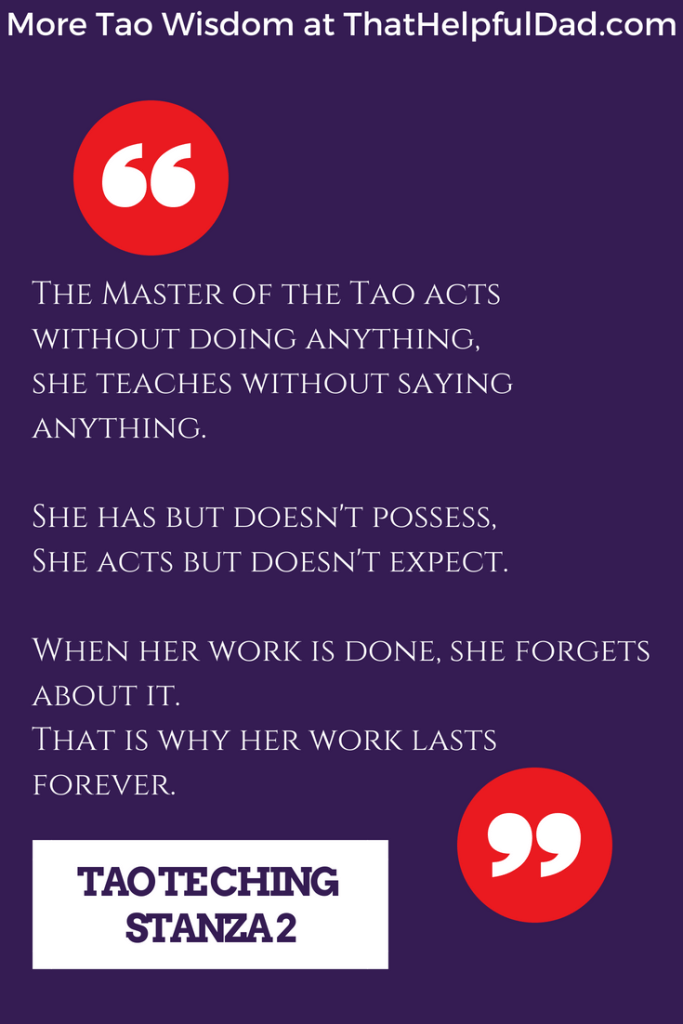
Tao Stanza 2

The Master of the Tao acts without doing anything. She teaches without saying anything. She has, but doesn’t possess. She acts but doesn’t expect. When her work is done, she forgets about it. That is why her work lasts forever. 

(Text Version)

Tao Stanza 7

The Master stays behind, that is why she is ahead. She is detached from all things, that is why she is one of them. Because she has let go of herself, she is perfectly fulfilled. 

(Text Version)

Tao Stanza 8

In dwelling, live close to the ground. 
In thinking, keep to the simple.
In conflict, don’t try to control.
In work, do what you enjoy.
In family life, be completely present.

(Text Version)

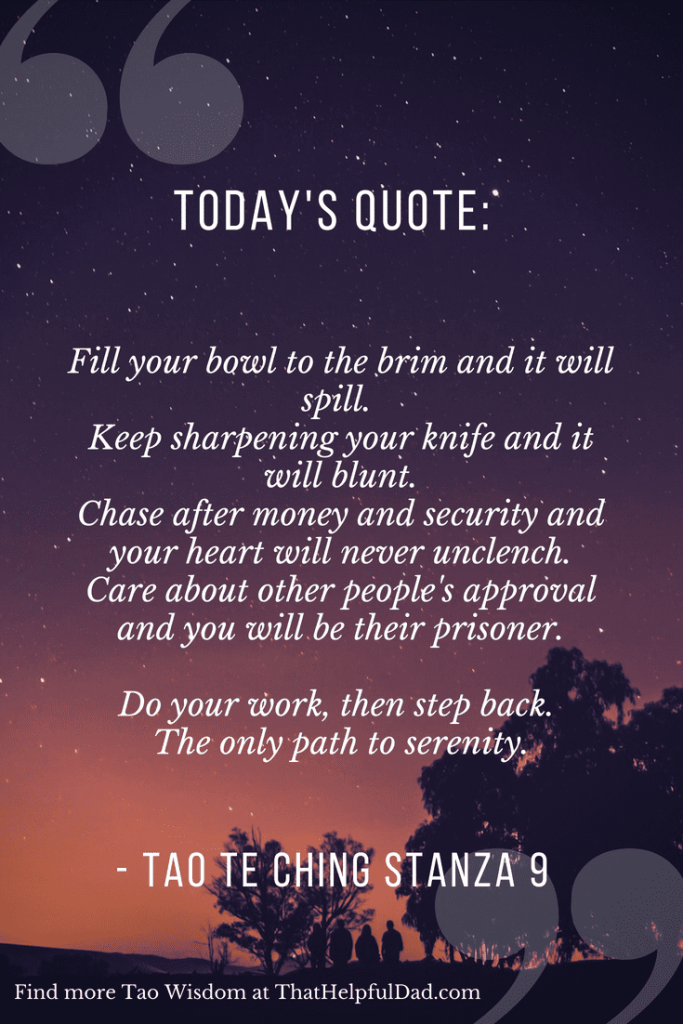
Tao Stanza 9

Fill your bowl to the brim and it will spill.
Keep sharpening your knife and it will blunt.
Chase after money and security and your heart will never unclench. 
Care about other people’s approval and you will be their prisoner. 
Do your work, then step back. This is the path to serenity. 

(Text Version)

Tao Stanza 10

Giving birth and nourishing, having without possessing, acting with no expectations, leading and not trying to control: this is the supreme virtue. 

(Text Version)

Tao Stanza 11

We join spokes to make a wheel, but it is the center hole that makes the wagon move.

We shape clay into a pot, but it is the emptiness inside that holds what we want.

We hammer wood for a house, but it is the inner space that makes it livable.

We work with being, but non-being is what we use. 

(Text Version)

Tao Stanza 15

Do you have the patience to wait till your mud settles and the water is clear? Can you remain unmoving till the right action arises by itself?

That Master doesn’t seek fulfillment. Not seeking, not expecting, she is present and can welcome all things. 

(Text Version)

Tao Stanza 22

The Master sets an example for all. Because he doesn’t display himself, people can see his light. Because he has nothing to prove, people can trust his words. Because he isn’t supposed to be anyone, people can recognize themselves in him. Because he has no goal in mind, everything he does succeeds. 

(Text Version)

Tao Stanza 23

Express yourself completely, then keep quiet. 

Be like the forces of nature: when it blows there is only wind; when it rains there is only rain; when the clouds pass the sun shines through. 

(Text Version)

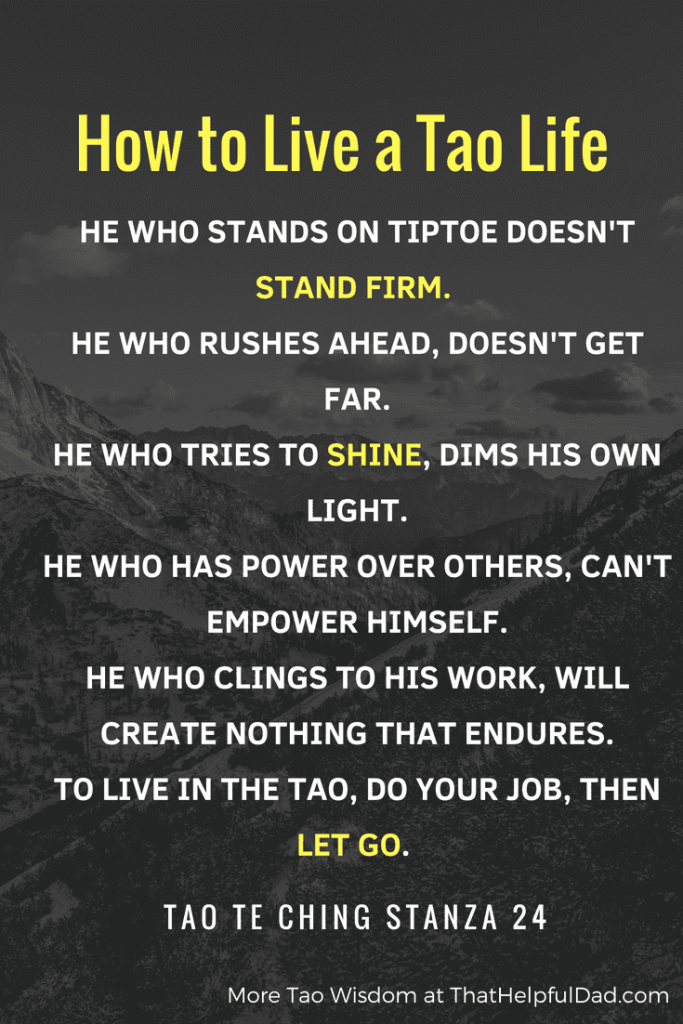
Tao Stanza 24

He who stands on tiptoes doesn’t stand firm. He who rushes ahead, doesn’t get far. He who tries to shine, dims his own light. He who has power over others, can’t empower himself. He who clings to his work, will create nothing that endures.

To live in the Tao, Do your job, then let go. 

(Text Version)

Tao Stanza 27

What is a good man but a bad man’s teacher? 

What is a bad man but a good man’s job?

(Text Version)

Tao Stanza 29

The Master sees things as they are, without trying to control them. She lets them go their own way, and resides at the center of the circle. 

(Text Version)

Tao Stanza 30

Believe in yourself and don’t try to convince others.

Be content with yourself and don’t need other’s approval.

Accept who you are and the whole world will accept you. 

More Tao Wisdom Coming Soon

This brings us a little more than 1/3 of the way through the Tao Te Ching. Keep checking back for more as I create new images you can use to share the Tao wisdom with your friends. 

Do YOU have a favorite Tao Stanza? 

Let us know in the comments below. 

Never Miss a Tao Tip

Visit my home page to sign up for email alerts when new articles are published. 

Get Your Copy of The Tao Te Ching

Video Readings of The Tao

References to Learn More about The Tao

Here are some helpful links to learn more about The Tao Te Ching and Lao Tzu.

  1. The Tao Te Ching: https://en.wikipedia.org/wiki/Tao_Te_Ching
  2. Lao Tzu, AKA Laozi: https://en.wikipedia.org/wiki/Laozi
  3. Lao Tzu Teachings: http://www.laotzu.org/
  4. Lao Tzu GoodReadshttps://www.goodreads.com/author/show/2622245
  5. Complete Online PDF of Taohttp://www.with.org/tao_te_ching_en.pdf
  6. 81 Clickable Tao Te Ching Stanzas: http://thetaoteching.com/taoteching5.html

What to Read Next?

Ichi-Go Ichi-E – The Best of Anthony Bourdain Part 1

Remembering Tony – Part 1

If you follow my work, you know that I often write about legacy life topics in an attempt to inspire myself and others to consciously choose activities that will help us live our best lives possible. I first heard about the concept of Ichi-Go, Ichi-E while watching an Anthony Bourdain episode some months ago — and writing an article about that life lesson has been on my to-do list ever since.

It’s a shame that I waited until Tony’s passing to finally get around to writing it — clearly I have a lot to learn about the Ichi-Go, Ichi-E concept. My hope is that by bringing this life lesson to your attention, you’ll be able to apply it to your own life and reap the benefits it offers.

Editor’s Note: This article is part of a series of posts called “Remembering Tony” that focus on sharing snippets that remind us to savor The Best of Bourdain.  


What is Ichi-Go, Ichi-E?

In episode 68 (season 8, show #7) his “Parts Unknown” show on CNN, Anthony Bourdain was again visiting his long-time friend Masa Takayama — the world renown ‘god’ of sushi. During the show, Masa and Tony were sharing a meal with friends and that’s when Masa started talking about concept of Ichi-Go, Ichi-I, teaching us that we must savor the special moments in life because they only happen once…

“Ichi-Go, Ichi-E: In This Moment, Never Again”

The all-knowing source that is Wikipedia naturally has more to say on this concept and it’s actually quite good so I’d like to share it with you. Among the notations about Ichi-Go, Ichi-E are the following:

  1. The important of “treasuring meetings with people.”
  2. Other definitions: “for this time only,” or “one chance in a lifetime.”
  3. Critical Point —” even when the same group of people can get together again, a particular gathering will never be replicated, and thus, each moment is always once-in-a-lifetime.” Masa talked about this very thing with Tony too.

This is sage advice. This is life-changing, life-improving advice!

Imagine how much your life would be improved if you applied the wisdom of Ichi-Go, Ichi-E to the special moments of your life — those special moments that occur every day — if you merely pay attention to them and be present for them.


IchiGo, IchiE … In Pictures

All too often we left the moments of our life pass us by without truly savoring them. Sure we might enjoy them and have a good time, but if we’re honest with ourselves, a lot of the time our minds are elsewhere and we’re not fully engaged. We take the good times for life for granted because while we are living them we foolishly believe that they will occur again and again.

Ichigo Ichie
A moment with a friend | Source – Pixabay CCO

Ichi-Go, Ichi-E teaches us to think differently. It teaches us to recognize life for what it is — a precious gift that is not guaranteed. Once we understand that mindset, we can begin to appreciate the good times even more.

Ichigo Ichie
Savor good times, special people | Source – Unsplash CCO

Whether it’s with family, friends, our favorite pet, or visiting a special place…

Ichi-Go Ichi-E
Man Dog Mountain Life | Source Unsplash CCO

…If you live by the motto of Ichi-Go, Ichi-E, you’ll learn how to suck the marrow out of life and enjoy all that it has to offer — just as Anthony Bourdain did during the time he was with us.

Anthony Bourdain
Ichi-Go Ichi-E, Tony

RIP, Tony. Thanks for sharing your life with us, my friend.


What to Read Next?

https://thathelpfuldad.com/anthony-bourdain-books/

https://thathelpfuldad.com/there-is-beauty-everywhere-if-you-only-look/

https://thathelpfuldad.com/there-is-no-guarantee-of-tomorrow-dont-wait-to-enjoy-your-life/


Never Miss an Article

Subscribe to our blog – it’s free and you’ll get all my tips by email to read at your leisure…


On Being Content – Tao Wisdom

Fame or integrity – which is more important?
Money or Happiness – which is more valuable?
Success or Failure: which is more destructive?

If you look to others for fulfillment, you will never be truly fulfilled.
If your happiness depends on money, you will never be happy with yourself.

Be content with what you have; rejoice in the way things are.
When you realize there is nothing lacking, the whole world belongs to you.

Today’s wisdom comes to us from The Tao Te Ching (English Version, Chapter 44)

The words are easy to understand, but the lesson is a hard one to learn. I will admit it’s one I still struggle with.

Thankfully the first step towards a better life is taking a step in the right direction — are you willing to take that step with me and use this wisdom today?