Manti Te’o – when you hear the name you think of one thing – ‘he’s that football player fool who got catfished by another dude.’ But if that’s all you know about him, then you don’t really know Manti Te’o and you’re missing the chance to discover a hero that can inspire us all.
Manti Te’o ’s life is the story of What Might Have Been versus What Is. As an All-American football player, Manti might have led Notre Dame to the 2013 National Championship. As a Can’t Miss prospect, Manti might have been a 1st draft draft pick in the NFL. Given his off the chart talent Manti might have gone on to become an NFL Hall of Fame linebacker and enjoyed a lifetime of rabid fans forever shouting his name. All this and more might have become Manti’s life’s story, yet none of them ended up being Manti’s reality.
As it turned out, Notre Dame got destroyed by Alabama in the 2013 College Football Championship game. While Manti did get drafted by the NFL, it wasn’t until the second round — as a result he lost millions of dollars by his draft status fall. And although he did play in the NFL for eight seasons, his chances of making the Hall of Fame are the same as mine and yours – zero.
And yet, for all the things Manti Te’o might have become but failed to achieve, there is something that he is – and always has been – a HERO that should inspire us.
Everyone knows the catfish story about how another guy duped Manti into an online relationship with a fake female persona back when Manti was at Notre Dame. The story is so outlandish that you probably concluded that either Manti was an evil prick who was part of the hoax or else he was an incredibly stupid fool to let himself get catfished so publically. Either way that story is now old news, so you’ve probably long since written Manti Te’o off as just another loser whose ten minutes of fame have thankfully long since gone away.
But then you watch the Netflix documentary Untold: The Girlfriend Who Didn’t Exist and you realize that you were the fool to think you knew what Manti Te’o was all about, because by dismissing him without a second thought, you’re missing the best part of the story – the part that matters the most – you’re missing the fact that Manti Te’o did become a hero – a hero who can inspire more than just football fans, a hero who can inspire us all.
What makes someone a Hero? We could argue about what the word Hero means, but in the time before words got changed to drive political agendas, most people would probably agree that a hero is someone who faced incredible adversity, who fought through it with persistence instead of giving up, and who ultimately overcame their challenge in a way that inspires others. If that hero can display bravery and a selfless compassion for others all the better. I believe that if you take the time to learn the rest of his story, you will see that Manti Te’o IS a hero – he’s always been a hero – and we can all learn something from him.
That Mant Te’o was a hero growing up in Hawaii and later at Notre Dame is without question – his laundry list of accomplishments on the football field and volunteer work in the community would make any parent proud to call him ‘son.’ By his senior year at Notre Dame he was beloved by fans everywhere, and with his entire adult life still before him it appeared that the world was his oyster – fortune and glory was within reach – but then he got catfished and everything changed. .
What really happened with the catfish situation? When you examine the facts, it seems likely that Manti Te’o was a naive kid with a good heart who got caught up in a web of lies by another person that Manti should never have trusted. Had Manti not been famous, the catfish scenario probably would not have devolved into the mess it became, but unfortunately for him, Manti’s success at the time attracted a media circus that propelled the story into everyone’s daily news feed. When Manti finally realized there was a problem with the girlfriend who never was, it was too late – he was too young and ill equipped to stop the media machine that was actively feeding off his never-before-seen story.
Manti describes the events of that time like a ‘Tidal Wave that swept his life away’ – he became trapped into riding that wave, hoping it would end, yet powerless to stop it. Events spiraled out of control despite his best efforts. Manti’s life was just getting started and he was on the verge of superstardom when the catfish incident derailed not just his NFL career, but his entire life, and that of those around him. The amazing life story that might have been for Manti, and probably should have been — suddenly never was.
Manti tried to pursue his football dreams – yet he couldn’t escape his public shame. Playing in the NFL kept him in the spotlight, and with the power of 24/7 social media, Manti remained the butt of countless cruel memes, the punchline of comedians’ jokes, and he suffered constant abuse from former fans whenever he took the field. Even when the rest of us eventually laughed the story away, Manti was forced to deal with the aftereffects of it in the years that followed – not just what it did to him personally, but also how it affected his family. The abuse was surely crushing.
By all accounts Manti Te’o should have been destroyed by the public ridicule he took – a lesser man would have killed himself many times over during that long ordeal. Watching the documentary and seeing the classy way Manti Te’o carries himself is both heartbreaking and inspiring. I see Manti’s tears and I want to cry for him – for all the pain he had to endure and for all that he lost in life. The process should have torn him apart. I’m sure it did. Yet like any true hero, Manti Te’o did not give up – facing adversity beyond his strength, Manti says he fell back to what he knew was his foundation – his family and his faith.
That he was able to survive such a tidal wave of adversity is perhaps a one in a million chance. That he was able to eventually thrive is a testament to his courage and character. Manti not only weathered the storms but became stronger for it. Perhaps this is because Manti didn’t seek revenge against his abuser, but instead Manti’s faith gave him the strength to somehow forgive the person who so cruelly took advantage of him.
The Netflix documentary delves deep into the alleged motives of the person behind the catfishing incident – a (now) transgender individual named Roniah. Regardless of Roniah’s reasons for stringing Manti along, the fact is that Roniah ruined Manti Te’o’s life – or at least the life that ‘might have been.’ As described in the documentary, Roniah preyed upon Manti Te’o’s innocence and his catfishing of Manti led to Manti’s NFL draft status fall – costing Manti and his family untold millions of dollars in lost contract money (and possibly even more in lost endorsement deals). And yet, somehow, Manti still had the compassion to forgive his abuser for his/her sins. It takes a true hero to display that kind of compassion.
Like Manti, all of us live through the ‘seasons’ of life – the carefree spring, the joyful summer, the rest period of fall, and the sadness of winter. Manti was in the springtime of his life when he got catfished – he was young, healthy, and had unlimited potential. Manti’s summer season should have been one of money, fame, and the easy life of a surefire NFL star. Given his magnetic personality, Manti’s ‘autumn’ of life would probably have seen his post-NFL career move into broadcasting and/or church leadership. But that’s not what happened – Roniah’s cruel catfishing propelled the young Manti from that wonderful spring directly into a dark winter – a winter that should have destroyed him – and that should have been the end of Manti Te’o.
Yet wisdom tells us ‘There is no winter that lasts forever; the spring will always come’ and that’s true for Manti Te’o too. Fot it seems the end of our story is instead a new beginning – as it turns out Manti finally found the summer of life he missed out on so long ago. Oh, he never did become a football superstar – instead Manti became something more: a happily married husband, a loving father, and someone who showed us that, no matter how big the storm, there is always a path back to happiness. By forgiving his abuser and persevering, Manti Te’o has become a hero not just in the NFL, but for the world.
Today I’d like to share with you one of the tips my wife and I have used to improve our parenting skills – it’s called the Family Bedtime Chat. The concept is simple – before we all go to bed, we meet as a group in one of the bedrooms and everyone gets a chance to tell about their day (what they liked and perhaps what they didn’t). It takes less than 5 minutes to do and yet those 5 minutes are often some of the best ‘family time’ of the day. Perhaps you might give it a try with YOUR family too?
How our Family Bedtime Chats Started
We’ve been doing Family Bedtime Chats for about 6 years now. They’ve developed over time, but the concept has remained the same. My wife, my kids, and I all take turns briefly talking about our day. I started the idea when my sons were 2 and 7 respectively and the original idea was for each person to tell the group 1 thing they liked about the day.
The reason I came up with the idea was because I was trying to help my boys understand the concept of “Now Moments” – those treasured moments of life that make life better and which occur every day if we simply take the time to recognize them. I had no idea the little life lesson I was trying to teach would turn into a family tradition that’s lasted so long, but it turned out my family really loves them and they’ve become such a habit that it’s something we try to do every day – even I’m travelling for work or a couple of us are camping for scouts, we’ll spend some time on the phone together to do our bedtime chat. It’s just part of who are are as a family now and that’s something I’m so grateful for.
The Roadblock that almost killed our Chats in the very beginning.
This tradition wasn’t always roses. While our older son (Jax) was happy to participate along with my wife and I, our youngest son (JeeHo) has always been a bit of a tough nut and at first he didn’t want to talk at all. We didn’t force him to talk if didn’t want to, but we still made him sit and listen to the rest of us so he could hear about our day. He was ok with that. After a couple weeks he was willing to talk a bit – however JeeHo preferred to tell us something he did NOT like about his day!
That was a bit of a twist but we let JeeHo run with his idea and to encourage him further all modified our routine by having everyone tell 1 thing they like and 1 thing they didn’t. JeeHo then 1-upped us again by happily telling us all about the many things he did NOT like about his day (he didn’t like dinner, his older brother Jax teased him, he fell and hurt himself, etc) and sometimes we’d get a tiny thing he maybe liked (playing with Jax, Daddy reading to him, swimming, etc). Over time, JeeHo has grown out of ONLY talking about the bad things and now he happily shares the many things he likes about his day – although to this day his daily chat almost always includes something he didn’t like. (Hey, you can’t win evey parenting battle right?)
What our Family Bedtime Chats are like today
Over the years our chats have morphed – we no longer have the ‘structure’ we had in the early days. Instead it’s just a matter of getting together as a group and each sharing something – it could be about what happened that day, or maybe something they are looking forward to the next day, or maybe it’s about a problem they’re having, or in JeeHo’s case some idea for a new invention he has cooking. Very often I’ll talk about something I’m grateful (for example: “I’m thankful that God has blessed us by letting us all be here together, that we’re all happy, that we love each other, and that we’re healthy.”
All told the entire chat takes 3-5 minutes then we give everyone a quick kiss and it’s off to bed.
The Priceless Aspect of our Family Bedtime Chats
Let me share with you perhaps my favorite thing about our bedtime chats – it’s a tradition within a tradition so to speak. Our oldest son Jax had to overcome verbal apraxia and sometimes it takes him a bit of time to think of what he wants to say. The bedtime ritual was a bit challenging for him at first and so to give himself time he would often say “I like right now” before telling us something else he liked about his day. That phrase “I like right now” always touched my heart because Jax is a sincere person and I knew when he said that – even though it was giving his mind time to think of something else – it was 100% true.
For my oldest son to tell us that one of his favorite parts of the day was to be sitting with his family chatting before bed was incredible to me.
To this day, he still says “I like right now” every time we do a bedtime chat – and very often one 1 or more of the rest of us will say it too. It’s truly priceless.
Who has time for a Bedtime Chat?
I get it – life is hard and it often pulls us in many different directions. Especially as the kids have gotten older and have gotten involved in after school activities (sports, homework, friends, etc, etc), time flies each day. Throw in trying to have a family dinner, get cleaned up, and maybe have a bit of time to watch some Netflix before bed and there’s not a lot of time before bed. I’m sure it’s the same for you. But, like I’ve mentioned, a bedtime chat doesn’t have to take an hour – invest just a few minutes (literally 3, 4, or 5 minutes) and you’ll build a family lifeline that will pay you massive dividends by keeping a regular line of communication open with your kids.
Make Family Bedtime Chats part of your Evening Routine.
Regular readers know I’ve professed the benefits of the Morning Routine for years – getting a jump start on your day with a bit of structured habits sets you up for success – but what about your EVENING Routine? You probably have a lot of things you do nightly before you go to bed, right? Why not add a bedtime chat with your family into the mix?
Spending a few minutes with your kids talking about your day can yield tremendous benefits and is a great ROI for your time so give it a try and start your first Family Bedtime Chat tonight. You’ll be glad you did!
Wanted to share my new favorite preworkout supplement with you – Nitro Surge. If you follow my blog you’ll know I’m a big fan of living a health lifestyle – I’ve been doing Intermittent Fasting for 5 years, I meditate daily, and I try to exercise 5-6 days a week. I’m over 50 and so far God has blessed me with great health (and I pray that continues). I’ve written about workout supplements in the past and today I want to tell you about Nitro Surge – a product I’ve been using for nearly a year now.
If you’re looking for a great preworkout supplement to add to your routine that will give you results consider giving Nitro Surge a try.
Disclaimer – please make sure you are healthy enough to workout, you use the product per the directions, and of course you check with your doctor first to ensure you can tolerate the ingredients of Nitro Surge. My recommendation is based on my own personal experience and your results or tolerance for the product may be different than mine so, as always, exercise caution with this or any supplement.
What is a PREWorkout Supplement and why might you want one?
If you want an in-depth discussion of a preworkout supplement, there’s a great article about this on Masterclass.com and I recommend you check it out, but the basic gist is that a “pre-workout is a supplement that can increase energy levels, improve exercise performance, and stimulate muscle growth. The ingredients and effects of pre-workout supplements vary by product, but most products use ingredients like caffeine to provide an energy boost or creatine to help increase muscle mass. Athletes typically consume pre-workout supplements as pills or as powders mixed into drinks and you can also mix pre-workout supplements with protein powders, which can help stimulate protein synthesis and build muscle.”
Now that I’m over 50 the energy level is not what it was when I was 25. I need a bit of a jump start to get going. This is the reason why I take a preworkout supplement.
I’ve tried a bunch of preworkout supplements and there are other good ones (C4 is another preworkout supplement I like), but the best of the bunch, the one that consistently gives me a great workout time and again is Nitro Surge.
What is Nitro Surge?
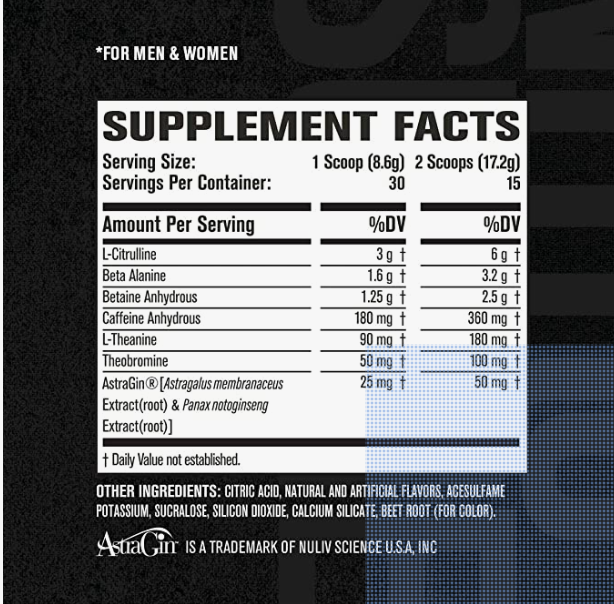
Nitro surge is a pre-workout for men and women that “delivers everything you need for explosive workouts laser-sharp focus, endless endurance, and powerful pumps.” I put that in quotes because that’s the company’s marketing message, however I can personally attest that these claims are all true.
Although the ingredients are different, Nitro Surge reminds me of my all-time fav preworkout supplement – Jacked3D from back in the day. Sadly the original form of Jacked3D is no longer available and I’ve had a devil of a time trying to find a preworkout supplement that gives me what Jacked3D did – specifically focus, energy, endurance, and a pump. Thankfully I discovered that Nitro Surge does all of that for me.
What are the main ingredients of Nitro Surge?
The formula for Nitro Surge contains L-Citrulline, Betaine Anhydrous, Beta Alanine, Caffeine, L Theanine, and it’s creatine-free. That last part is important in case you take a separate creatine powder – in which case you may NOT want more creatine in your preworkout supplement – that’s another reason why I like Nitro Surge.
Boosting nitric oxide (NO) levels is believed to improve your blood-flow to the muscle to maximize pumps, endurance, strength, and fuel muscle growth. NO boosters are a common ingredient in preworkout supplements and I personally believe in this theory because when I use a NO Booster I can ‘feel’ the pump when I’m working out and my muscles look bigger.
Nitro Surge is Made in the USA
According to the company, Nitro Surge is made in a USA cGMP-Certified Manufacturing Facility. This preworkout powder drink is made in a cGMP-certified facility using high-quality raw materials. Each bottle of Nitro Surge is tested for potency, authenticity, and purity.
My Favorite Workout Supplements
Make sure your ad-blocker is off in order to see the products that follow.
What’s YOUR Take?
Do you use Nitro Surge or another preworkout supplement? If so, let me know in the comments below.
I’ve been in the market for a stainless steel Everyday Pan every since we started upgrading to stainless steel cookware a couple years ago. During a recent family vacation at the always awesome Sand Cay Beach Resort in Longboat Key, we found ourselves using a particular pan, well, every day. It was a 12-inch stainless steel pan that turned out to be incredibly useful – it was just the right size to cook pretty much everything in from breakfast to dinner. We loved it so much we ordered one from Amazon so that it would be waiting for us when we got home. Best of all it was a great price. That pan was the Cuisinart 725-30D Chef’s Classic Stainless 12-inch Everyday with Dome Cover.
What is an Everyday Pan?
Whether you call is an All-in-One Pan or a Weeknight Pan or an Everyday Pan the concept is pretty much the same – these all-around, everyday pans are great for making meals after work and they serve in place of multiple other pans in the kitchen. Sometimes they have a long handle like a fry pan, sometimes they have two short handles on the sides, but the always seem to have sloped, rounded sides and are easy to use for making one-pan meals any time of day. With a wide base, the stainless steel version of the Everyday Pan can be your go-to for searing and browning meats, and those sloped sides allow you to use it to simmer stews or sauces. Best of all the stainless steel conducts the heat so well you don’t need to use high heat. I’ve also found them easy to clean (pro tip: if you get any stuck on foods, simply use a bit of cooking wine to deglaze the pan with a plastic or wooden spoon and cleanup is a snap).
I’ve wanted an Everyday Pan for awhile and there’s been numerous times when I wanted to pull the trigger and buy the All-Clad All-in-One Stainless Steel Pan. We love our other All-Clad pans and you’ll never go wrong with this brand, but the price of their All-in-One and Weeknight Pans are often upwards of $200 (as of June 2022) and with runaway inflation money just doesn’t seem to go as far as it used to anymore. Additionally, I didn’t want a long handle on my Everyday Pan.
We have other Cuisinart Stainless Steel cookware and we’ve been very happy with them, so when we discovered the Cuisinart Everyday Pan during our trip and ended up using it every day, well we were quickly sold. I love the short side handles on the pan and how easy it is to cook with.
Give this Everyday Pan a try and let me know what you think.
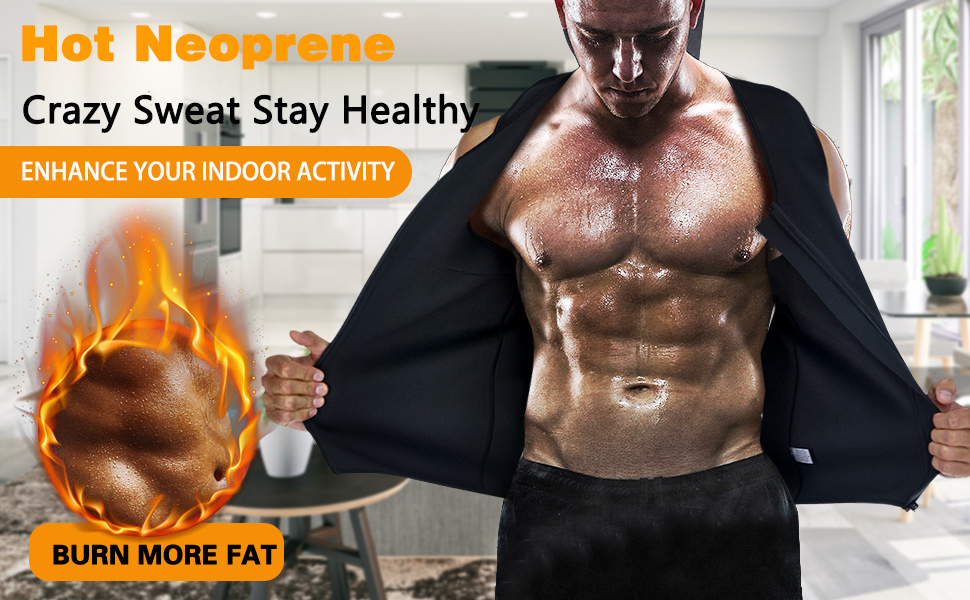
I recently discovered a great new product called the Wonderience Waist Trainer Vest which is a Hot Neoprene Sauna Suit in the form of a workout Tank Top. It’s a fantastic product that’s ridiculously inexpensive (I got it for under $20) and it really lives up to its claims. In this quick post I’ll tell you why I like it and where to get it.
Workout Sauna Vests – Why Wonderience is Different.
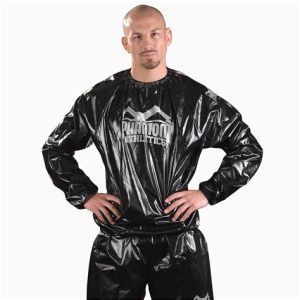
Sauna vests are nothing new – we’ve all seen the old style space suits from years past that force you to sweat by encapsulating you in de facto plastic – while those old style sauna suits do work, the problem with older sauna suits is that they are way TOO HOT and uncomfortable to wear for very long, they look ridiculous, and nobody really wants to wear them.
Old, Uncomfortable Sauna Suits
Wonderience Sauna Vest
The Wonderience Sauna Vest is different. I’ve worn this vest for HOURS and have never gotten overheated – in fact it’s comfortable I don’t realize I have it on sometimes. I DO sweat beneath the vest (which is great), but I do NOT get overheated (which is even better) and I can wear the vest as long as I like.
As an unexpected bonus, the vest acts like a body shaper and it improves your posture by encouraging a proper posture form – awesome!
Wonderience Workout Sauna Vest
Here are the specs on the Wonderience Sauna Vest:
Interior material: Neoprene
Zipper closure
Sauna vest with Zipper burn fat more than regular gym clothing, helps posture for back and abs as you workout
Making you sweat like crazy when you workout keeps you body warm during cold days with minimal thermal cover with this underwear ,This Corset training vest can be worn under or over your regular shirts
Vests burn more fat, produce heat in a workout wearing Sauna Vest and accelerating your fat burning
Material produce higher compression resulting in more sweating and help your body to sweat out harmful fats. Enhances the abdominal and spinal support
Wear the Shaper under jacket or dress around the house, when you’re exercising, running errands or going out. You’ll have a firmer posture, lower back support, and be sweating all day.
Shop Wonderience Sauna Vest
MIKE’s PRO TIP – if you do get one be sure to get the one with the ZIPPER FRONT – it makes it super easy to get on and off. You don’t want to be messing with trying to put this on like a normal shirt because it will be too tight. Get the zipper version and you’ll thank me.
Why Over the Ear Wireless Headphones are Great for the Gym
Going to the gym is great, but when the gym’s music is blasting tunes you don’t like it can put a real damper on your workout, right? I wear headphones so I can listen to the music I want to listen to not what the gym employees want. And I choose wireless phones because I can’t be messing with wires when I’m trying to work with weights.
Why I choose Over the Ear Headphones over Ear Buds
In ideal world, ear buds would be the choice because they are smaller than over the ear phones. Unfortunately, even the best noise-cancelling ear buds just don’t seem to block out the background noise as effectively as over the ear headphones. That’s why over the ear wireless phones are my preferred choice for working out at the gym. Are over-the-ear phones bulkier than ear buds? Sure, but over the ear headphones also do the best job of getting rid of outside noise and distractions – that means you can listen to the music you love and translate that into an awesome workout – and isn’t that what’s important when you go to the gym?
Best Over the Ear Headphones for Gym – Best Sound Quality Overall
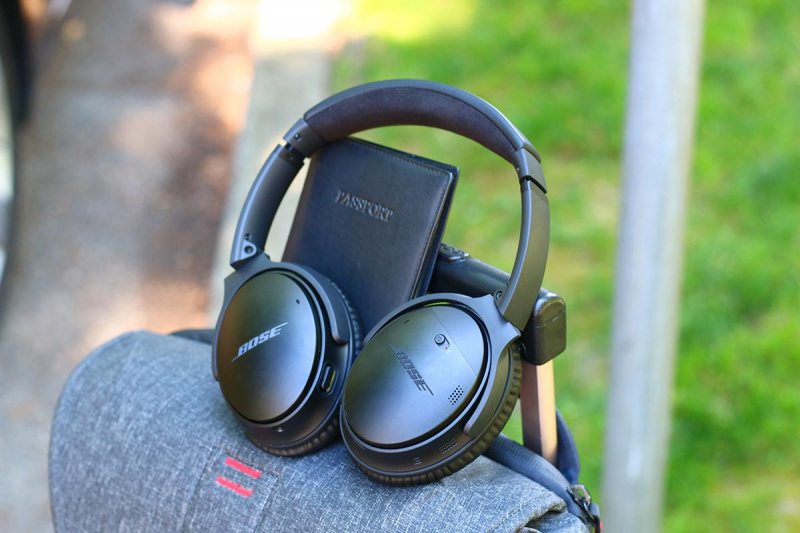
If your budget allows, there is no real competition for the best over the ear headphones for the gym in terms of overall SOUND QUALITY and active NOISE CANCELLATION – the Bose QuietComfort 35 II.
Why is the Bose QuietComfort 35 II the Best Over the Ear Headphones for the Gym?
Industry leading ACTIVE Noise Cancelling blocks outside music and noise better than anything else on the market. Less Distractions = More Focus on your Workout.
Adjust your level of noise cancelling between three settings using the Action button or the Bose Connect app.
Volume-optimized EQ gives you balanced audio performance at any volume and makes Bose QC 35 the best over SOUND QUALITY on the market for all types of music in general (EXCEPT for heavy bass music where the Beats is superior – see below).
Super Comfortable Ear Cups
Easy Bluetooth pairing.
20 hours of battery life.
Bose QuietComfort 35 II vs Bose QuietComfort 35 (original)
The Bose QuietComfort 35 II and the Bose QuietComfort 35 (original) are nearly identical but for an “Action” button.
Here’s the official word from Bose “QuietComfort 35 headphones II offer the same unmatched combination of acclaimed noise reduction technology, wireless freedom, audio performance, dual-microphone system and 20-hour battery life as QuietComfort 35 headphones. However, QuietComfort 35 wireless headphones II also have a new Action button on the left earcup. In countries where the Google Assistant is available, that button gives you instant access to the Google Assistant, your own personal Google. In countries where the Google Assistant is not available, it lets you quickly toggle through three different ANR settings for optimal performance wherever you go.”
Personally we don’t think you’ll get much use of the Action button at the gym and if you can find the Bose QuietComfort 35 original edition than go with that – the problem is they’re hard to find and Bose is really only promoting the QC 35 II now as well as their new 700 model (below).
Bose QuietComfort 35 II vs the new Bose Noise Cancelling Headphones 700
You could go with the Bose Noise Cancelling Headphones 700 if you really want to, but in our opinion the Bose Noise Cancelling Headphones 700 has been updated to serve meet the Quarantine Life Work from Home market and is not necessarily any better at the audio or noise-cancelling tasks than the Bose QC 35 II. If that’s true then why pay more for the newer model?
Here’s another one in the premium price category and it’s aimed at those who value heavy bass in their music – as well as style. For this category the best over the ear headphones for the gym are the renowned Beats Studio 3.
Why are the Beats Studio 3 the Best Over the Ear Bass Headphones for the Gym?
Like the Bose QuietComfort 35 II, the Beats have ACTIVE Noise Cancellation to block out distractions.
Real-time Audio calibration preserves a Premium listening experience – the full, rich sound on the Beats for rap, hip hop, and other heavy bass music is unmatched.
Fantastic STYLE with 7 different color options and Beats branding.
Comfortable ear cups to fit over any ear.
Up to 22 hours of battery life enables full-featured all-day wireless playback
Great Improvement – With the new Fast Fuel system a 10-minute charge gives 3 hours of play when battery is low. (This solves a big problem with earlier Beats phones).
Beats Studio 3 vs Bose QuietComfort 35 II
Let’s keep this very simple – if you listen to music that is heavy bass then get the Beats Studio 3.
Listen, we know style is important and lots of people go to the gym to show off – we’re not judging – so if you wanna look good by wearing the most recognizable pair of headphones on the market AND you wanna choose from lots of colors, then get the Beats Studio 3.
If you don’t care about people looking at you so much and/or you don’t listen to heavy bass music and you just want the best noise-cancelling and pure sound quality, then get the Bose QuietComfort 35 II.
Best Over the Ear Headphones for Gym for Most People – Durability and Price
Let’s face it, most people probably can’t afford to spend the money on the Bose QuietComfort 35 II or the Beats Studio 3 – especially if you still need money to pay for that gym membership, right?
If that’s your situation, don’t worry, we’ve got a fantastic pair of over the ear wireless headphones that durable, have an insane battery life, and you can get them at a much lower price than the premium options: the OneOdio Bluetooth Over Ear Studio Wireless Headphones.
Why are the OneOdio Studio Wireless headphones the best for most people?
PRICE – you can buy 5 to 6 of these for the price of 1 Bose or Beats!
INSANE BATTERY LIFE – up to 80 hours of wireless play!
Never Lose Sound – with Dual Mode & Never Power Off features, when the wireless battery runs out you can switch to wired mode until you can recharge again.
Deep Rich Sound – Large 50 mm speaker unit drivers combined with neodymium magnets provides stereo sound, powerful bass, clear vocal, and crisp high tones.
Comfortable Ear Cups – ergonomic designed memory ensure long lasting comfort.
Although they don’t feature the same “Active” Noise Cancelling technology of the Bose or Beats, you may not notice the difference because the OneOdio Studio Wireless ear cups fit so well they are really good at blocking out distractions and playing your music.
OneOdio Studio 3 vs Bose QuietComfort 35 II vs Beats Studio 3
Over the years I’ve had lots of headphones – including the Bose, Beats, OneOdio, Cowans, Audio-Technicas, and more.
I love my Bose for sound quality but I don’t like taking them to the gym because they are so expensive and I don’t wanna get the ear cups all sweaty and have the phones break down on my faster – I prefer to keep my Bose for travel and home use.
The Beats I gave to my pre-teen son since he cares more about style and listens to more of the music style that the Beats are best for.
For me, I prefer the OneOdio Studio Wireless as the Best Over the Ear Wireless Headphones for the gym and here’s why…
The OneOdio Studio Wireless are the ones I personally use for the gym because they are durable, sound great, block out distractions, are comfortable, and I pretty much never have to charge them. I use them every day and I can’t tell you the last time I charged them – it’s really crazy! And you just can’t beat the price!
The OneOdio are my 2021 Editor’s Choice Award for Best Over the Ear Wireless Headphones for the Gym.
We live in troubled times – just like the disciples of Christ did. We are plagued by feelings of fear, weakness, pride, anger, and more – just like Christ’s apostles were. Which begs the questions – are their lessons we can learn from Jesus’ followers to help improve our own lives? I want to share an article with you that I read on The Federalist – it’s beautiful and I hope you enjoy it…
We revere the saints of the Gospels. Matthew and Mark, Luke and John, Peter, Philip and Simon, James, Andrew, Bartholomew, and Thaddaeus.
Their courage in spreading the Word from Ukraine to Egypt and from India to Spain, and their bravery when put to death, serve as examples most of us can only hope to approach. But it comes more naturally to follow their path on Holy Saturday when Jesus lay in the tomb and his handpicked followers cowered in fear. In these times, we might prefer to look at them as if apart from us — it’s easy, as we prepare for the vigil or for Easter morning. But in truth, these are the very days when we are most like the Twelve.
On his final journey to the cross, the Apostles failed and faltered repeatedly. They’d lived in the shadow of Christ, holding his hand, hearing his words, seeing his miracles, and yet they did not understand. Worse yet, they were afraid. Along with Judas Iscariot, they were among the first to follow the Lord — and the first to leave him: Judas, to betray and suffer damnation, but the others to fall asleep, to cower, to deny, and to hide. And from the beginning, it was so.
After hearing how Peter begged Christ not to go to Jerusalem to suffer his passion and die, we might wonder how he could dare rebuke God’s plan. But today, we know the journey Christ was on and we’ve heard it a thousand times; his Disciples walked it, and they were afraid.
Today, we know it was for Jesus to suffer, die, be buried, and rise again on the third day, and we know that he did this to free us from sin, yet still, in public and in private we disobey him. Every one of us, to some degree or another, is guilty. This is certain because we are human. Though firm in his command to a frightened Peter, Jesus explained just where his follower had erred. “You,” he said, “are thinking not as God does, but as human beings do.” The Lord knew why Peter was afraid, just as he knows why we are weak in our moments of trial, fearing sacrifice and death. Fearing pain.
“There is nothing more tragic in all the world than wasted pain,” the Venerable Archbishop Fulton Sheen once said. “Think of how much suffering there is in hospitals, among the poor and bereaved.”
Think also of how much of that suffering goes to waste. How many of those lonesome, suffering, abandoned, crucified souls are saying with our Lord at the moment of Consecration: “This is my body, take it?” And yet that is what we should be saying at that second. “Here is my body, take it. Here is my soul, my will, my energy, my strength, my poverty, my wealth—all that I have. It is yours. Take it! Consecrate it! Offer it!” Offer it to the Heavenly Father with yourself, in order that he, looking down on this great sacrifice, may see only you, his beloved Son, in whom he is well pleased. Transmute the poor bread of my life into your life; thrill the wine of my wasted life into your divine Spirit; unite my broken heart with your Heart; change my cross into a crucifix.
Sheen’s words are beautiful. They are comforting to meditate on. In them, we have the tools to face anything, yet while in my own private moments of anguish I have sometimes succeeded, I can vividly recall the times I have failed utterly and completely.
The Disciples had been told they were following Christ to his passion, and while they struggled to understand they followed him still to Jerusalem. It’s easy to plan to offer ourselves up in times of distress and great pain, but at the moment when panic, anguish, and real hurt rack us, more often man falls short.
Again and again, Christ’s chosen faltered just as we have and will. At Holy Thursday at his final Passover, even while Jesus confronted Judas and warned those gathered that his betrayer was among them, the Apostles argued over which of them should be regarded as the greatest. Though Peter, the rock on which Christ would build his church, was specifically warned of his coming sin, at the moment of trial Peter denied his Lord still.
When Jesus carried his cross to Golgotha, only a few — his mother, her sister, Mary Magdalene, and John, the youngest of the Twelve — followed with him. When God looked down from his cross, only one of the Twelve stood ready to hear the command to honor Mary, his mother. While the Son of Man lay in the tomb, as he said he would for three days, his Apostles hid from the high priests and the mob; only the woman were there on Easter to speak with the angels.
“Surely not I, Lord,” we assure ourselves when we hear of their failings — just as the saints who built the church assured themselves at the Last Supper. But we live our lives in lust and anger, laziness and greed, pride and gluttony. We give in to temptation, we don’t do what we know we should, we tend to our bodies over our souls, and we hold ourselves in arrogance above perfect strangers. We drink and we drug with food, alcohol, pills, television, whatever we can get our hands on; and we judge others for doing the same as we do, or simply choosing a different vice than our own.
Christ knew all of this of course. He did not come because the Apostles were saints, nor because we are, but because men are guilty. He knows our weakness intimately because he became man: God and man at once, a mystery on full display in the garden Thursday night when the Son asked the Father if he might take this cup away from him. He knew God’s will be done, and he knew the Holy Spirit would soon come upon the men who, just feet away from his agony, could not stay awake for even his final hours.
And when they nailed his hands and his feet, he felt pain.
How often have we questioned God’s plan? In our heart of hearts, how many of us have felt angry, even? For ourselves, maybe, but for the innocent, too. Why must they suffer, we ask God. What have they done? It’s the same suffering that brings us to our knees, praying for their health, their loved ones, and their souls. It is the same suffering that, C.S. Lewis wrote, is God’s “megaphone to rouse a deaf world.” A God who lived in poverty, and a God who suffered.
This Holy Saturday, while we wait in expectation for Easter Sunday, remember those mere men in the Bible. Their fear and their weakness are not foreign at all — they are you and me. And with the Holy Spirit, they built Christ’s church.
Over the last couple of years my family has been upgrading our home audio system and our home theater system inside the house and on the outside patio area and after much research we chose to go with SONOS products. Unfortunately we discovered that it’s kinda hard to do that easily because there are so many Sonos products and it’s hard to know which one you need for which purpose. Luckily I found an informative article that helped me and I wanted to share it with you in the hopes that it will be useful to you as well.
One of the easiest ways to add music to lots of rooms in your house is with Sonos.
Sonos is easy to set up and control wirelessly with your smartphone or voice. And it’s cost-effective compared to hiring a custom installer. We can help you get started. Read on for advice on what you need to add wireless multi-room audio to your life.
How to use Sonos for wireless music
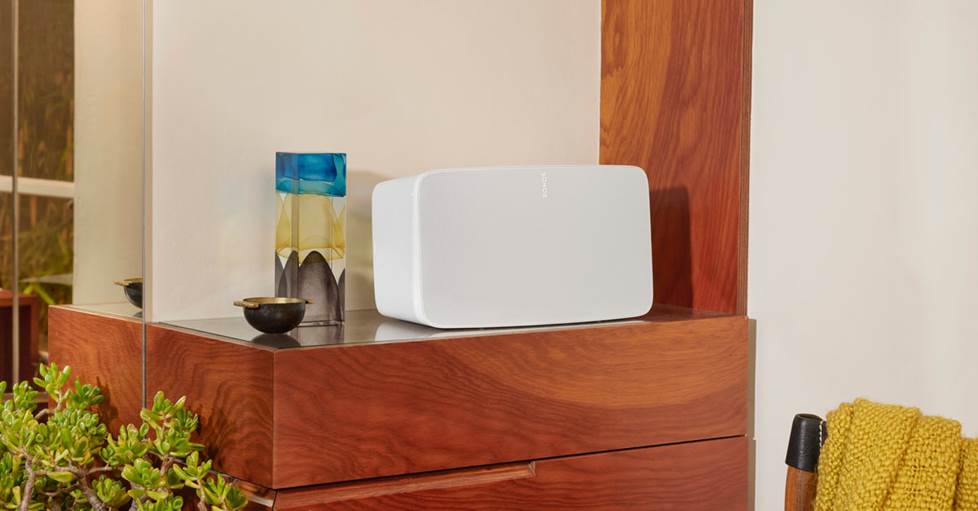
If you want to replace your current speaker system or add music to different rooms, Sonos offers a variety of powered speaker models (each is available in black or white).
Sonos speakers and sound bars are also compatible with Apple AirPlay® 2. This lets you stream directly from iOS devices (like an iPhone®) and use Siri to play Apple Music selections (with subscription). It also lets you stream Netflix and YouTube soundtracks to your Sonos speakers as the video plays on your device.
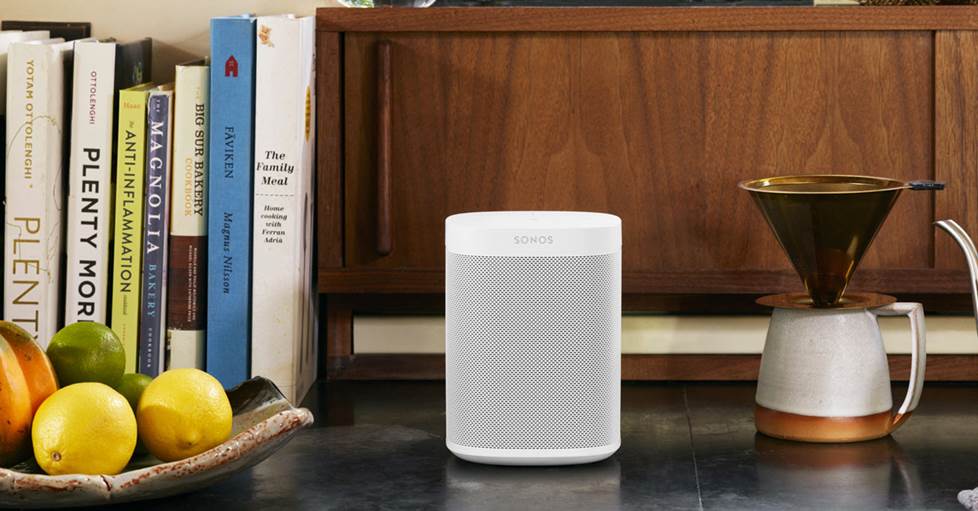
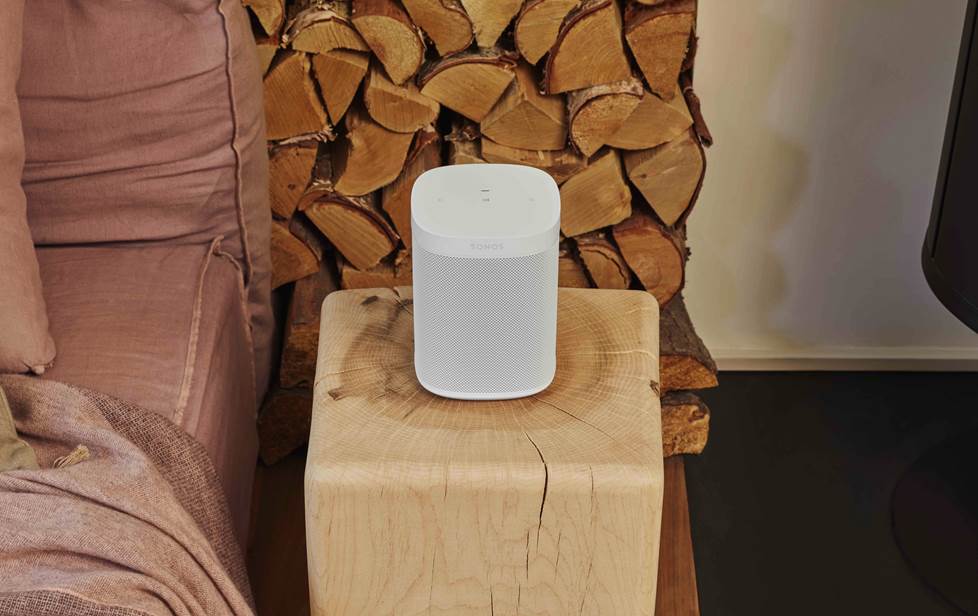
The Sonos One SL is great for smaller rooms where voice control is not needed.
Great for: smaller rooms like a bedroom or a dining room. The Sonos One SL is virtually identical to the Sonos One, except it doesn’t have any voice control capabilities.
Built-in speakers: 2 full-range drivers
Placement: tabletop; wall- or stand-mountable
Sound: well-balanced with clear detail and expansive sound field
The portable Sonos Move lets you take your music anywhere.
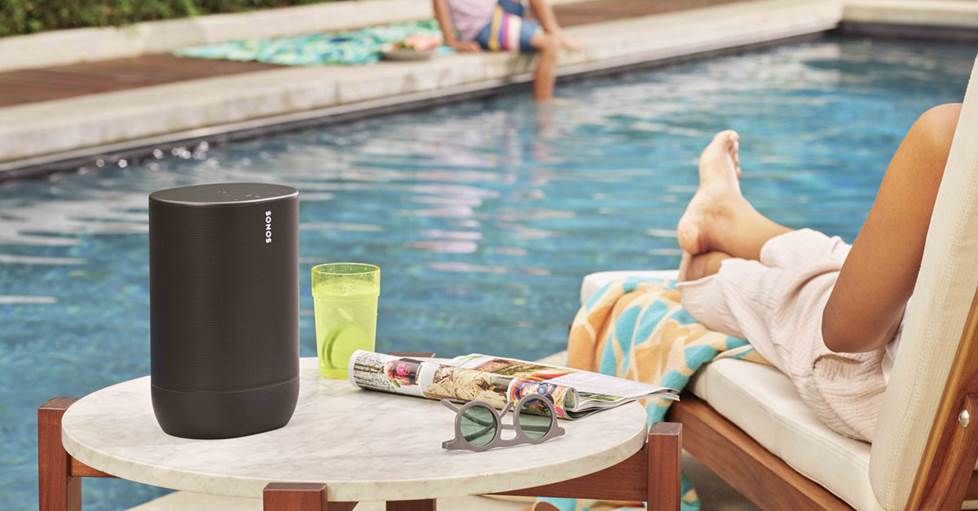
The Sonos Move is a portable wireless Sonos Speaker with a built-in rechargeable battery. When it can connect with your home Wi-Fi, it can be a part of your Sonos multi-room system. You can also take it anywhere you would any portable speaker (it’s waterproof), and use it as a Bluetooth speaker.
Great for: decks, patios, and on-the-go listening
Built-in speakers: 2 full-range drivers
Built-in voice control: Amazon Alexa and Google Assistant
Placement: tabletop
Sound: clear and balanced with full-sounding bass
Weather Resistant: With an IP56 rating, Move stands up to humidity, rain, snow, dust, salt spray, UV rays, and extreme heat and cold
Durable: Don’t worry about accidental drops or bumps. Move’s components are protected by a hard-wearing, shock-resistant case
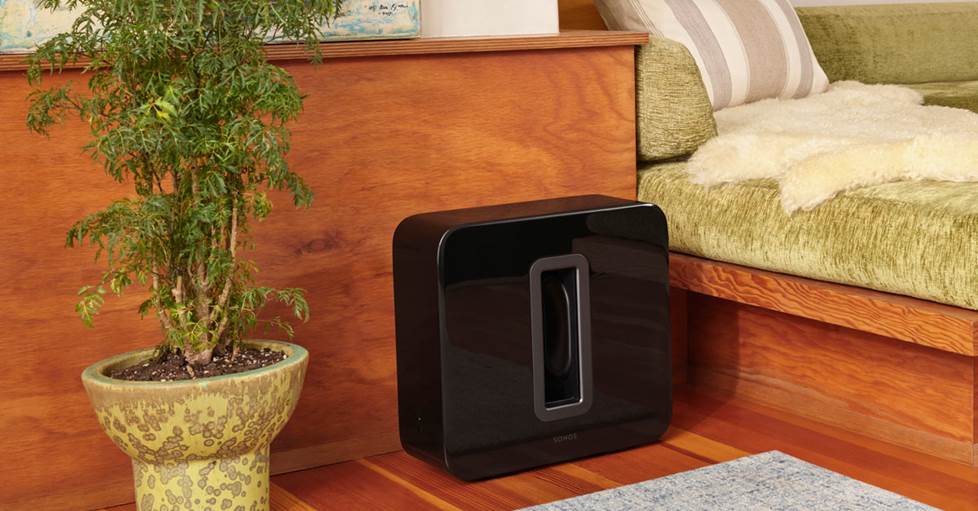
If you’re really serious about excellent sound with plenty of deep bass, we recommend adding a Sonos Sub to a pair of Sonos speakers.
The Sonos Sub features dual woofers and acoustic ports, so it will fill out the low frequencies. It’s great for a system that will rival some pretty nice receiver-and-speaker setups (it’s also great for movies and TV — keep reading). You can also pair the Sub with a single Sonos speaker, though we recommend using it with stereo pairs.
Tip: Use two Sonos wireless speakers in the same room for bigger sound
All Sonos speakers can be set to function in stereo pairs, for a wide stereo image and left/right separation. It’s a great option for large rooms where a single speaker may not be enough. Here’s a vid showing you how to create a Sonos Stereo Pair…
Of course, you can only pair like to like. So you can pair two Sonos One speakers or two Sonos Five speakers or pretty much any combo you like.
The Sonos Port allows you to enjoy all the wireless music benefits of Sonos speakers through your existing stereo system. It offers digital and analog audio outputs, so you can connect it to an integrated amplifier, preamp, stereo receiver, home theater receiver, or powered speakers.
I have the Port myself and it was one of the first Sonos components we purchased. It’s Easy to set up and it’s pretty much a set-it and forget it kind of device – which is awesome!
~That Helpful Dad
The Sonos Port lets you tie your existing stereo setup into a wireless multi-room music system – using Sonos speakers or your existing ones.
The Sonos Amp is a versatile amplified player for use with any pair of stereo speakers. Just connect your speakers to the terminals and start streaming tunes wirelessly. It also has mono subwoofer output, for a 2.1 audio system.
You can connect a TV to a Sonos Amp and stream its audio to other Sonos speakers in your system. It also has analog inputs for connecting a source component like a CD player, as well as a preamp output for a powered subwoofer.
Use the Sonos Amp to enjoy Sonos with a pair of stereo speakers.
TIP: You can use the Sonos Port and Sonos Amp with multi-room installations with in-wall or in-ceiling speakers
You can use multiple Sonos Port music players along with stereo or multi-room amplifiers to power in-wall or in-ceiling speakers in several rooms. It’s a great way to enjoy music throughout your home while all the gear remains out of sight.
The Sonos Amp makes it easy to add in-wall, in-ceiling, or outdoor speakers to your wireless multi-room music system.
If you want to put together a system for your TV room or home theater, Sonos has some cool options that offer great sound and wireless music capability, including:
Each option has its own advantages. Sonos home theater systems can play wireless music from the same sources as all the other Sonos components. And these sound bars let you stream audio from your TV to Sonos components in other rooms.
Placement: cabinet-top — designed to provide a platform for your TV
Sound: spacious, powerful sound with strong bass; clear TV and movie dialogue
Sonos Beam vs Playbase vs Playbar
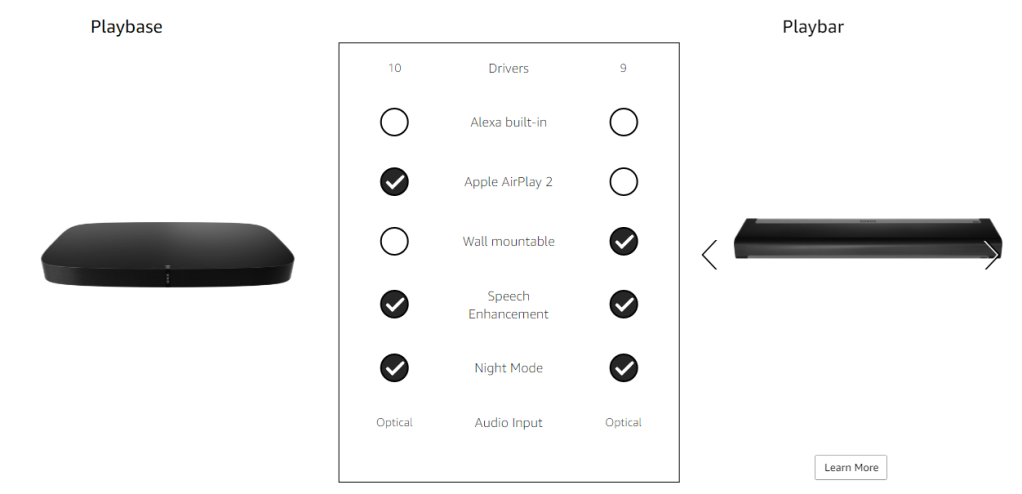
The following comparisons will help you understand the differences between the Sonos Beam vs Playbase vs Playbar.
Sonos Playbase vs Beam
Sonos Playbase vs Playbar
TIP: Add a Sonos Sub to expand your Sonos Home Theater System
The Sonos Sub can be paired wirelessly with any of these sound bars to expand and strengthen the low register, adding dimension to your TV and movie sound.
Playbar and Sub — the Sonos sound bar and subwoofer offer dynamic, impactful sound for movies and TV.
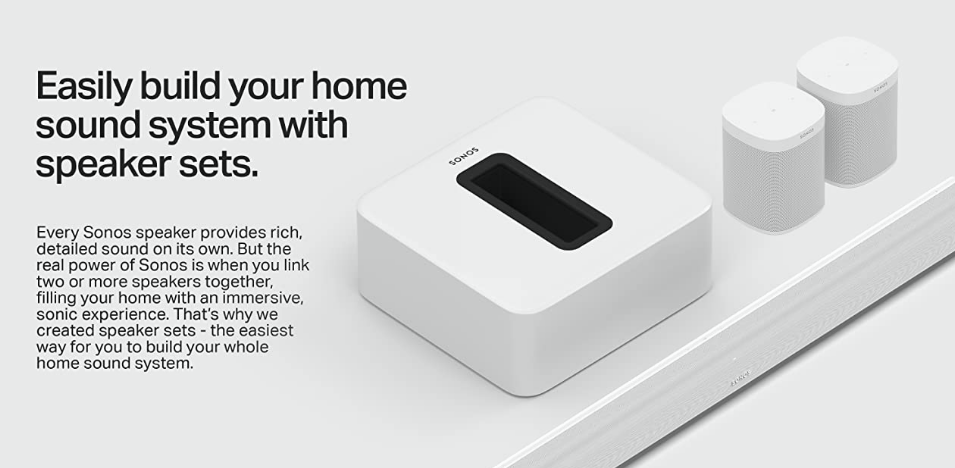
You can use two Sonos One, or Sonos One SL speakers as surround speakers with your Sonos sound bar. Along with the Sub, this gives you a 5.1-channel surround sound system for immersive sound in your home theater.
A great way to add surround speakers is to purchase a bundled set of Sonos speakers. You save money, and — depending on the bundle — you can add more speakers for additional rooms.
Enjoy a wireless home surround sound setup with Sonos components.
Shop Sonos Store on Amazon
Get even more ideas from the Sonos store on Amazon – click the pic to see more…
Readers of my blog know how much Intermittent Fasting (IF) has changed my life for the better – I started with IF back in 2017 and haven’t looked back. You can read about my journey with IF here, but today I wanted to share an article with you that provides some of the science behind how Time Restricted Eating (TRE) like Intermittent Fasting can help to optimize your energy and combat fatigue – both benefits I can personally attest to!
New to Intermittent Fasting? Start with these articles:
The good news is there’s a lot you can do to improve your energy levels. One such strategy, which I embraced years ago, is time-restricted eating (TRE), a form of intermittent fasting in which you restrict all of your food intake to a certain number of consecutive hours each day.
As an added boon, this strategy doesn’t cost you a penny. If anything, it’ll save you money. Gundry was ahead of the curve on this one, having written about TRE in his first book, “Dr. Gundry’s Diet Evolution,” published in 2006.
“I had an entire chapter in that book devoted to time-restricted eating, and my editor at Random House at the time, Heather Jackson, said, ‘This is so crazy that I’m not going to let you do this.’
She said this. True story. And I said, ‘Look, I’m telling you, I’ve been doing this now for four years and I’ve been using it on my patients and it’s not crazy. Here’s the research.’ And she said, ‘OK. I’m going to give you two pages to make your case. I’m throwing the rest of the chapter away.’
So, I got two pages. I saw her at the mindbodygreen symposium last summer, before the COVID-19 outbreak. She came up to me and said, ‘You were right. I apologize. You weren’t crazy, you weren’t nuts. Everybody now knows.’”
Indeed, in recent years, TRE has gained a lot of recognition as mounting evidence shows the simple act of restricting the number of hours during which you consume food during the day will improve your health in a variety of ways, primarily by improving your mitochondrial health and metabolic flexibility.
As noted by Gundry, keeping your eating to a window of six to eight hours a day is an achievable goal for most people. However, most need to gradually ease into it.
“Metabolic flexibility is probably the underlying problem in the vast majority of diseases that we see and I wrote the book to try and make it easy,” Gundry says. “What I see in my practice is that a lot of people go, ‘OK. I usually eat breakfast at 7 and starting tomorrow I’m going to start eating breakfast — break-fast — at noon.’ And they fall flat on their faces.
They get headaches, they get hungry, they don’t think right. They have no energy and they decide ‘This isn’t for me.’ That’s because they have a high insulin level, they’re insulin resistant and can’t use stored fat as an energy source …
So, in the book, what I do is, over a six-week period, I get them used to eating during a shorter and shorter time window. It’s very much like learning a new exercise program. I couldn’t run a marathon right out the gate, but I can train and get there. So that’s what we do.”
Part of the process involves retraining your circadian rhythm. Your food intake, which impacts the circadian rhythm of your gut microbiome, and other circadian rhythms are intricately connected, and the more you can realign these circadian rhythms, the better your whole body will function, including your mitochondria.
Crucial Notes on Meal Timing
At the most extreme end of TRE is the one meal a day (OMAD) routine, which can work well if you’re young and healthy. However, once you get into middle age and older, I believe it can start to backfire. I’m also not convinced that it’s healthy to remain on an OMAD diet in perpetuity, for the simple reason that your body will typically work best when you challenge it now and then.
During winter months, about six months out of the year, Gundry promotes using a two-hour, or even as short as a single-hour eating window during weekdays, and then eating during a much longer window during weekends. He’s been doing this for the past 21 years.
For me, cycling — mixing longer and shorter fasting intervals — has been a key to long term success, and taking the weekends off from this strict regimen may be part of why this strict regimen has worked so well for so long for Gundry.
“I think you’ve got to break it up. I don’t do it all year around, and I break it up on the weekends, and the reason I do that is so I won’t go mad,” Gundry says. Another important detail with regard to timing is to avoid eating at least three hours before bed. Even if you restrict your eating to six hours or less, if you eat too close to bedtime, you’re canceling out many of the benefits. As explained by Gundry:
“It’s really important to stop eating at least three hours before bedtime for a couple of really important reasons. No. 1, you’ve got to undergo mitochondrial repair during the night.
You have to undergo brain cleaning during the night from the glymphatic circulation. Digestion takes huge amounts of blood flow, and if you’re eating, all that blood flow is heading down to your gut when it should actually be going up to your brain.”
TRE Makes Most Diets Better
Gundry quotes data from Satchin Panda, which shows that rats raised on a standard American diet equivalent that also are put on a TRE regimen fare much better than those who are not on TRE. This despite the fact that they’re eating the same thing. The same has been shown to hold true in humans.
Remarkably, Panda has shown the average American eats for 16 hours a day. Essentially, they’re grazing all day long, stopping only while sleeping. About 90% eat for more than 12 hours.
Simply reducing your eating window to 12 hours would be an improvement. As noted by Gundry, “Big Food, Big Agriculture have convinced us that this is the proper way to eat.” In reality, the only thing these big businesses and their recommendations are good for is disease.
The Case for EMF Avoidance
Gundry and I are also in agreement about the dangers of electromagnetic fields (EMFs). I’ve previously written about how magnesium can help mitigate some of the damaging effects from EMF, and Gundry has a patient who appears to have had success using this strategy. Melatonin, which is a very potent mitochondrial antioxidant, is another potential mitigator.
“Melatonin is a very interesting way of mitigating against the bad effects of EMF,” Gundry says. “Now, as I talk about in the book, I used to think that people who said that they were sensitive to these invisible rays [EMFs] were out on the lunatic fringe.
But the longer I’ve been doing this, I’ve had some fantastic experiences with very credible people, who when we mitigated EMF got well. One patient was profoundly affected by her husband’s AICD, a defibrillator, which was communicating his EKG with a satellite.
As soon as it went into him, she couldn’t sleep next to him. She had migraine headaches. We finally turned off the transmitter in his AICD, and just like that, all of [her symptoms] went away. So, these people are canaries in a coal mine and we have to believe it.”
Leaky Gut Underlies Most Chronic Disease
While antioxidants like melatonin can certainly help improve mitochondrial function, I think there are better ways than simply piling on antioxidants. You also need to remove dietary and lifestyle factors that cause the energy depletion in the first place. EMF exposure is one environmental factor. Leaky gut, caused by lectins in your diet, is another factor that needs to be addressed.
Leaky gut is an underlying condition of most chronic disease, so, if you have a chronic ailment, chances are you have leaky gut.
According to Gundry, leaky gut is an underlying condition of most chronic disease, so, if you have a chronic ailment, chances are you have leaky gut. Thanks to Dr. Alessio Fasano, who heads up the Celiac Research Center at Harvard, we now have sophisticated tests that can diagnose this problem.
Fasano discovered the mechanism by which lectins cause leaky gut, and gluten is a lectin. When these and other food particles are able to cross your gut lining, they cause chronic inflammation, which requires a lot of energy to combat. This is one reason for your fatigue and general malaise. Gundry explains:
“If your immune system is distracted down to your leaky gut, first of all, it’s not going to be available when [pathogens] come in through your nose or mouth. And secondly, your immune system is so hyperactivated that when it sees something that might not be all that important, it goes crazy and you get a cytokine storm. That, of course, is one of the major lethal consequences [of] the Western diet.”
Linoleic Acid Can Decimate Mitochondrial Health
Another dietary factor that decimates mitochondrial health, and thus energy production, is omega-6 linoleic acid (LA). “In the book, I talk about the Goldilocks effect,” Gundry says. However, LA is naturally found in virtually all foods, so it’s near-impossible to become deficient. The problem really is excessive intake, which is near universal in Western countries due to processed food.
The primary culprit here is industrial vegetable oils, which most people eat far too much of. If you’re eating a whole food diet, you’re more likely to have a healthy ratio of LA, but even then, it may be causing trouble if you’re eating too many LA-rich foods, such as conventional chicken, for example.
You can learn more about the mechanisms of action behind LA’s damage in “Why Chicken Is Killing You and Saturated Fat Is Your Friend” and “The Type of Fat You Eat Affects Your COVID Risk.” Olive oil is another food that is high in LA, but it also has other components that may modify some of the risks. Still, I choose to limit my olive oil intake. Overall, I try to keep my LA intake below 5 grams a day, regardless of the sources. Gundry has a more favorable view of olive oil, stating:
“If you limit your eating window, you actually stop that process from happening, which is really miraculous, No. 1. And No. 2, shameless plug for myself, with my Gundry MD high-polyphenol olive oil, you only need a tablespoon a day to get the equivalent polyphenols of a liter of olive oil a week.”
Surprising Benefits of Cheese
When it comes to fats, Gundry is a proponent of short and medium chain fatty acids. “For multiple reasons, I’ve been extolling the virtues of MCT oil since the ‘Plant Paradox,’” he says, adding:
“I think the saturated fats have other benefits. In particular, the saturated fats in cheeses may be one of the unsung heroes in longevity that I think needs more attention … I take care of a huge number of people who carry the APOE4 mutation, which is the Alzheimer’s mutation. I noticed early on that cheese really elevated not only small dense LDLs, but also elevated for most of my patients’ oxidized LDL …
I don’t like the traditional cholesterol theory of heart disease. On the other hand, I think oxidized LDL has an interesting place. What’s interesting is that when I’ve separated my patients into having them eat sheep cheese and goat cheese, I found dramatically different results.
I initially attributed it to the fact that sheep and goat have casein A2 and not casein A1. And I think casein A1 is a pretty bad actor. So, I said, well, I’m going to start letting my APOE4 [patients] have sheep and goat cheese, but in moderation. When I did that, I didn’t see this oxidized LDL.”
One potential mechanism for this might be because casein is a protein that can cause autoimmune reactions and contribute to leaky gut, which in turn contributes to increased LDL oxidation.
While most of Gundry’s autoimmune disease patients respond extremely well to Gundry’s plant paradox program, about 10% still do not fare well. Food sensitivity analysis has revealed a large number of them are sensitive to both casein A1 and casein A2.
Once their leaky gut is repaired, however, which may take up to a year, their immune systems typically become tolerant to these things again. “So, I think you can retrain the immune system once you get a good microbiome and seal the leaky gut.”
What About Meat?
While some autoimmune patients have reversed their conditions using a carnivore diet, popularized by Dr. Paul Saladino, who is a leading authority on the science and application of the carnivore diet, Gundry recommends limiting meat because of its effects on your gut microbiome. Interestingly, Gundry will be interviewing Saladino very shortly and that interview will be on his site. It should be a fascinating discussion.
“I have nothing against the carnivore diet as an elimination diet,” he says. “In fact, when Saladino was first on my podcast, he credited me as being the father of the carnivore diet because all plants are evil. And I went, ‘Please don’t do that to me.’
I think one of the mistakes that people make in, particularly, a keto diet where they’ve eliminated fiber, you actually starve your gut microbiome from making butyrate. The other, I think worrisome, part about a carnivore diet is you tend to make more hydrogen sulfide. I’m a huge fan of hydrogen sulfide, the rotten egg smell … but again, we get the Goldilocks rule …
Some is really good for you, it’s really good for mitochondrial function, but a lot is really toxic. And there’s some evidence with carnivore diets that you produce too much hydrogen sulfide. Now, I also understand the argument that if we eat a lot of gristle and a lot of mucin, basically nose to tail, that you can make butyrate by fermenting protein-based animal ingredients. I think you can.
But if you look at all the super long-lived folks, one of the things they have is really great production of butyrate. Butyrate, that short chain fatty acid, does so much good for mitochondria, I can’t even begin to tell you. Well, I do in the book.”
I agree that a strict no-carb diet is a mistake. Healthy carbs — think plant foods rich in fiber — need to be cycled in, there’s no question. Not every day, but certainly once or twice a week, even when you’re on a ketogenic diet. I recommend restricting carbs to about 50 grams or so for most of the week, and then increasing that to 100 or 150 grams once or twice a week once you’re metabolically flexible.
Protein, mTOR Activation and Exercise
Meat, of course, is also a source of protein, and while too much protein can be harmful by activating mTOR (thereby contributing to cancer and other problems), too little can be an unmitigated disaster, as I found out.
For a time, I aggressively restricted protein in an effort to minimize mTOR, and ended up developing sarcopenia (muscle loss). The lesson here is that you need protein, especially if you’re working out, and especially as you get older. With regard to mTOR activation, Gundry notes:
“The only way we can actually measure the effect of mTOR long term is insulin like growth factor IGF-1. I take care of a lot of super old people, 95 and above. I have a lot of 105-year-old patients that I study, and they all have very low insulin-like growth factors.
We’ve tried experiments with patients, really reducing their animal protein and replacing it with plant-based protein. I’m not taking protein away. Their insulin growth factors will drop 50 to 70 points in a matter of months, and I think that’s pretty interesting.
The other thing that’s interesting is that exercise will actually change your gut microbiome to eat branch chain amino acids before they get into you, and branch chain amino acids are one of the biggest stimulators of mTOR.
That’s why, if you’re building muscle and you’re a body builder, you gulp branch chain amino acids all the time. So, I think, probably Saladino — who exercises and also does TRE and has pretty good IGF-1s — can tolerate a very high animal protein diet.
The other thing that I’ve written about in all my books is that beef, lamb and pork have a sugar molecule called Neu5Gc, and fish and chicken have Neu5Ac. Many people make an autoantibody to Neu5Gc, so they attack their own blood vessels if exposed to beef, lamb and pork.”
Lastly, Gundry points out the importance of exercise. When you work your muscles, especially the big muscle groups, myokines are produced, which help grow new brain cells and aid your mitochondria. However, contrary to popular opinion, you don’t need to exercise continuously for 30 to 60 minutes each day, Gundry says. It’s OK to break it into smaller segments.
“Even walking up and down stairs for a minute may be as effective as walking 10 minutes on a level surface,” he says. “Doing a plank while you’re watching TV for a minute is a phenomenal exercise. My favorite is when you’re brushing your teeth, do deep knee bends, do squats.”
A few years ago I told you how I discovered a Bed of Nails acupressure mats and that I loved it so much I put it on my Essential Guide to Awesomeness list. Later the product earned one of my Editor’s Choice awards. Since I first discovered it, I’ve pretty much been using my Bed of Nails every day, yet the product became an absolute MUST HAVE for me during the Covid plandemic lockdowns that started in 2020 and currently show no signs of ever ending. My bed of nails is one of the key products that has helped me keep my sanity during these crazy times.
FYI – I have the one by SPOONK in the middle
What is a Bed of Nails?
A Bed of Nails is an acupressure mat that you lay on – it has gentle plastic spikes that provide self-healing benefits from a combo of acupuncture and massage.
How does it work?
Bed of Nails originated over 1,000 years ago and was used by gurus in the practice of meditation and healing. Bed of Nails acupressure mats use a modern, ergonomically designed version of that ancient technology, with a Swedish twist, to model those same deep healing effects. With thousands of non-toxic plastic nails, harmless to the skin but with all the healing benefits of its legendary ancestor.
Acupressure has been used for centuries to promote self-healing by rejuvenating and rebalancing the body.
A Bed of Nails works on the simple principle of acupressure by pressing the stimulation points on the skin to increase circulation and aid relaxation in the inflamed and painful muscle area, relieving muscle, nerve, and back pain. a bed of nails can provide the benefits of a deep tissue massage that lowers the “stress hormone” cortisol while releasing endorphins (or “feel good hormones”), which help create an overall more positive and relaxed state of mind.
Does a bed of nails hurt?
That depends on how you choose to use it. With a bed of nails, YOU control the intensity of the acupressure. There are many options. For example…
How I use my Bed of Nails
Personally I use the “extra intensity” method and I lay on my bed of nails bare skin to mat.
When you use this method you’ll experience a gamut of sensations. When I first started doing this I would describe it as somewhat painful initially, however once you get through the first 5 minutes you start to reach a state of bliss. After 20-30 minutes, you’ll reach a state of ‘gelatinous euphoria’ where the cares of the world melt away.
I know use my Bed of Nails every night while reading or watching tv in bed and I regularly lay on it for 30, 45, even 60 minutes or more – it does wonders for relieving the stress of the day!
10 Benefits of using a Bed of Nails
People who use a bed of nails like me believe some or all or the following are the benefits of using a bed of nails…
Reduce pain in back, neck, shoulders, hips and joints.
Improved circulation. Improved Digestion.
Increased energy levels
Release tension and find a deep sense of relaxation.
Relaxing muscles and joints. Decreased muscular tension.
Minimizing headaches. Reduce blood pressure.
Increased levels of endorphin. A positive mental outlook.
Increased uptake of oxygen.
Improve sleep quality and relieve insomnia.
Fibromyalgia relief
I can’t speak to the Fibromyalgia relief or whether it reduces headaches, blood pressure, or increases O2, but…
I can tell you FOR SURE that my bed of nails reduces my stess/tension, reduces pain in my back/shoulders, improves my sleep, and gives me more energy.
Get a Bed of Nails for yourself today
If you follow my blog, you know that when I write an article about a product I only recommend products that I personally use and believe in. I’m telling you that my bed of nails is a product I can’t live without and I give it my TOP RATING.
Take my advice and consider getting a bed of nails for yourself today. As I mentioned before, I own one made by Spoonk but there are plenty to choose from on Amazon. Click the pic below and see for yourself – I have it auto-sorted by the most popular 4-star rated bed of nails choices. Your best bets are likely the following market leading brands: Nayoya,Spoonk, Bed of Nails brand, and ProSource Fit.
Shop Here – Click the Pic to see these and many more bed of nails options.
FYI – I have the one by SPOONK in the middle
After you get one and start using it, let us know how you like it.
Enjoy!
Practical Wisdom YOU can use today to make a difference in YOUR Life